
- Quick Answer: What Is HSMaaS and When Do You Need It?
- What Is an HSM and How Does It Work?
- EC's HSM as a Service
- Deployment Models: Dedicated vs Managed HSM
- FIPS Boundary: What It Means for Your Keys
- High Availability and Key Ceremony
- Integration Prerequisites and Application Interfaces
- Advantages of HSM as a Service
- Failure-Mode Guidance
- Conclusion
- Frequently Asked Questions
HSM as a Service (HSMaaS) provides FIPS 140-2 or FIPS 140-3 validated hardware security module infrastructure without the capital cost and operational complexity of managing HSM appliances directly. The provider operates dedicated, tamper-resistant HSM hardware; the customer retains exclusive control over key material in a cryptographically isolated partition. Cryptographic operations including key generation, encryption, decryption, and signing occur inside the FIPS-validated hardware boundary, and keys never leave that boundary in plaintext. The recommended action: identify which workloads require hardware key custody, confirm the FIPS 140 level required, and evaluate whether dedicated or managed HSM delivery meets your policy and operational needs.
Quick Answer: What Is HSMaaS and When Do You Need It?
HSMaaS is hardware security module infrastructure delivered as a managed service. The underlying hardware provides the same FIPS-validated tamper resistance and key custody as an on-premises HSM; the service model eliminates hardware procurement, data center operations, firmware management, and staffing overhead. Use HSMaaS when workloads require hardware-rooted key protection (CA private keys, payment HSM functions, code signing keys, TLS private keys) and when the organization lacks the expertise or capacity to operate HSM hardware directly. For a broader decision framework, see our Enterprise Guide to HSMaaS.
What Is an HSM and How Does It Work?
A Hardware Security Module (HSM) is a tamper-resistant physical device that generates, stores, and manages cryptographic keys and performs cryptographic operations inside a hardware boundary from which keys never emerge in plaintext. HSMs are validated under FIPS 140-2 or the current FIPS 140-3 standard. FIPS 140 validation levels range from Level 1 (working algorithm, production-grade equipment) through Level 4 (active tamper response, environmental attack detection).
For most enterprise workloads, FIPS 140-2 Level 3 is the standard: it adds tamper-resistance, identity-based authentication, and the requirement that critical security parameters leaving the HSM are encrypted. Keys generated in the HSM use a hardware random number generator (TRNG) compliant with NIST SP 800-90A. Authorization to use HSM-protected keys requires physical smartcards, PINs, or equivalent multi-factor credentials, preventing software-only attacks from accessing key material even with privileged host access.
To further protect against breaches, HSMs are isolated from the general computer network, operating as a separate physical or network-attached device. An attacker without physical access to the HSM cannot retrieve protected key material even with full access to the host operating system.
EC’s HSM as a Service
Encryption Consulting’s HSM as a Service provides the highest level of security for certificate management, data encryption, fraud protection, and financial and general-purpose encryption workloads. Key characteristics of EC’s HSMaaS offering:
- FIPS 140-2 Level 3 and PCI HSM approved: validated at the hardware appliance level, not only the software layer.
- Globally compatible and vendor-agnostic: EC works with multiple HSM vendors and selects the hardware that best matches the customer’s requirements, budget, and compliance needs.
- Customizable, high-assurance HSM solutions: on-premises and cloud deployment options designed to organizational and regulatory specifications.
- Highest availability: cluster-based deployment with replication across appliances; geographic redundancy available.
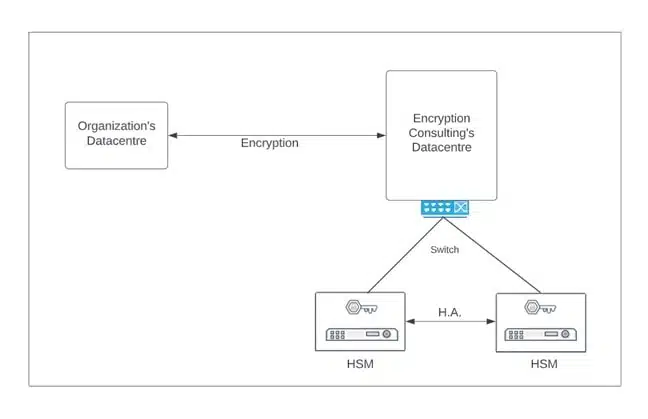
EC’s HSMaaS is suitable for organizations that already have HSMs deployed and need management support, and for organizations building new HSM infrastructure from scratch. Being vendor-agnostic, EC provides options across major enterprise HSM platforms including Entrust nShield.
Deployment Models: Dedicated vs Managed HSM
Dedicated HSM
The customer receives a complete, single-tenant HSM appliance with full administrative control. Best for:
- Organizations requiring FIPS 140-2 Level 3 or higher validated devices with total and exclusive control over the HSM appliance.
- Workloads where no shared hardware is acceptable by policy.
- High-performance use cases requiring dedicated cryptographic throughput.
- Migration scenarios where the organization is moving from another HSM platform and needs a clean, isolated environment.
Managed HSM
EC takes complete operational responsibility for the HSM environment (cloud, hybrid, or on-premises), including provisioning, configuration, patching, and maintenance. The customer retains control over key material in their partitions and sets access policies, but delegates hardware management. Best for:
- Organizations with HSM infrastructure already in place that require ongoing expert management rather than self-management.
- Organizations building new HSM deployments where in-house HSM expertise is limited.
- Workloads that need FIPS-validated key custody without building an internal HSM operations capability.
FIPS Boundary: What It Means for Your Keys
The FIPS 140 boundary is the physical and logical perimeter within which all cryptographic operations occur. Keys generated inside the boundary are never exposed in plaintext outside it. For HSMaaS, this means:
- Key generation occurs inside the HSM hardware using a hardware random number generator.
- Signing and decryption operations occur inside the hardware; only the result (signature or plaintext) exits the boundary.
- Key backup operations export key material only in encrypted form, wrapped by the HSM’s backup key, which itself never leaves the hardware in plaintext.
- The provider cannot access customer key material in plaintext; the partition architecture enforces this at the hardware level.
High Availability and Key Ceremony
EC’s HSMaaS deploys HSMs in clusters with key material synchronized across multiple appliances. Single appliance failure is transparent to connected applications; the cluster continues serving cryptographic operations from surviving appliances. For geographic high availability, key material is replicated to clusters in secondary locations using the HSM’s encrypted backup mechanism.
For CA root keys, HSM master keys, and other highest-sensitivity keys, a key ceremony is required at HSM initialization. The ceremony ensures no single person holds complete key material and produces a signed audit record. EC supports key ceremony planning and execution as part of the HSMaaS engagement. Key ceremony credentials are distributed across multiple custodians using M-of-N quorum authorization; losing fewer than M custodians does not jeopardize key access.
Integration Prerequisites and Application Interfaces
EC’s HSMaaS supports standard cryptographic interfaces for application integration:
- PKCS#11: the primary interface for most enterprise applications; compatible with Java, C, Python, and other language runtimes via standard PKCS#11 libraries.
- JCE (Java Cryptography Extension): for Java-based applications requiring HSM-backed key operations.
- Microsoft CNG / CAPI: for Windows-native applications and Microsoft CA (Active Directory Certificate Services) integrations.
- REST API: for cloud-native applications that cannot use a native HSM library.
Integration steps: install the HSM client software on application hosts, configure the application to route cryptographic operations to the HSM partition via the selected interface, test the connection, and verify that keys are generated and stored in hardware (not software fallback). EC’s team provides integration support across all major PKI systems, CodeSign Secure, and CertSecure Manager.
Advantages of HSM as a Service
- Tamper resistance at hardware level: tamper-evident, tamper-proof, and tamper-resistant hardware provides physical and logical protection that software key stores cannot match.
- On-premises and cloud flexibility: deploy in the location and model that fits operational requirements without being locked to a single topology.
- Full key material control: customer retains ownership and control over key material regardless of where application workloads run.
- Multi-cloud key management: extend hardware-backed cryptography and key management across multiple cloud environments through a single service.
- Elastic scaling: add partitions or capacity without hardware procurement delays.
- Compliance enablement: FIPS validation documentation, audit logs, and policy controls support evidence collection for PCI DSS, HIPAA, NIST SP 800-57, and other frameworks.
Failure-Mode Guidance
- HSM service unavailability: if the HSM cluster is unreachable, all operations requiring HSM private keys fail. Maintain a tested failover plan; for critical CA keys, a hybrid topology with on-premises backup is advisable.
- Lost quorum credentials: if M-of-N custodians are unavailable, partition access may be blocked. Assign backup custodians; test recovery annually using backup credentials in a non-production exercise.
- Expired certificates on HSM-backed keys: the HSM key remains valid but the certificate presenting it expires, causing connection failures. Use CertSecure Manager to automate certificate lifecycle management for all HSM-backed TLS certificates.
- Provider contract termination: confirm key export capability in encrypted form at contract signing; test export and re-import before the relationship begins.
Conclusion
HSM as a Service provides the same FIPS-validated tamper resistance and key custody as an on-premises HSM in a managed service model, eliminating hardware procurement and operations overhead while preserving complete customer control over key material. EC’s HSMaaS offers dedicated and managed deployment options, vendor-agnostic hardware selection, FIPS 140-2 Level 3 and PCI HSM approval, and integration support for PKI, code signing, and certificate lifecycle management. For more information, visit hsm-as-a-service or contact us.
Frequently Asked Questions
What is HSM as a Service?
A delivery model where a provider operates FIPS 140-2 or FIPS 140-3 validated HSM hardware on the customer’s behalf. The provider manages hardware, firmware, and physical security; the customer retains exclusive control over key material in a cryptographically isolated partition.
What is a Hardware Security Module and how does it work?
A tamper-resistant physical device that generates, stores, and manages cryptographic keys inside a hardware boundary from which keys never emerge in plaintext. HSMs are validated under FIPS 140-2 or FIPS 140-3. Level 3 (most common enterprise standard) adds tamper-resistance, identity-based authentication, and encrypted key extraction. Keys are generated using a hardware random number generator compliant with NIST SP 800-90A.
What is the difference between dedicated HSM and managed HSM?
Dedicated HSM: single-tenant appliance with full customer administrative control; the customer owns the hardware configuration. Managed HSM: EC manages provisioning, patching, and operations; the customer retains key material control in their partition. Dedicated suits organizations requiring exclusive HSM ownership; managed suits organizations wanting operational management outsourced.
What FIPS 140 level does EC’s HSMaaS support?
FIPS 140-2 Level 3 and PCI HSM approved configurations. FIPS 140-3 validated hardware is available through EC’s vendor-agnostic selection process. Always verify the FIPS validation applies to the specific hardware appliance in use, not only to the software management layer.
What are the advantages of HSMaaS over in-house HSMs?
No capital expenditure; provider handles firmware, monitoring, and physical security; scalable without hardware procurement delays; FIPS compliance documentation maintained by the provider; HSM expertise as a core function rather than a secondary IT responsibility. Disadvantage: network latency on cryptographic operations vs PCIe-attached on-premises HSMs.
How does EC’s HSMaaS integrate with PKI, code signing, and certificate management?
CA signing operations occur inside the HSM; the CA private key never leaves in plaintext. CodeSign Secure integrates with EC’s HSMaaS to protect code signing keys while the signing workflow runs in a CI/CD pipeline. CertSecure Manager manages certificate lifecycle for TLS certificates backed by HSM-stored keys, addressing both certificate expiry and key custody requirements.
- Quick Answer: What Is HSMaaS and When Do You Need It?
- What Is an HSM and How Does It Work?
- EC's HSM as a Service
- Deployment Models: Dedicated vs Managed HSM