
- Quick Answer: Why Is DNS Security Critical for Enterprises?
- Role of DNS in Cybersecurity
- DNS Threat Model for Enterprises
- DNS Vulnerabilities
- Protocol and Algorithm Selection for DNS Security
- Mitigation Strategies
- Deployment Example: Enterprise DNS Security Program
- How Encryption Consulting Can Help
- Conclusion
- Frequently Asked Questions
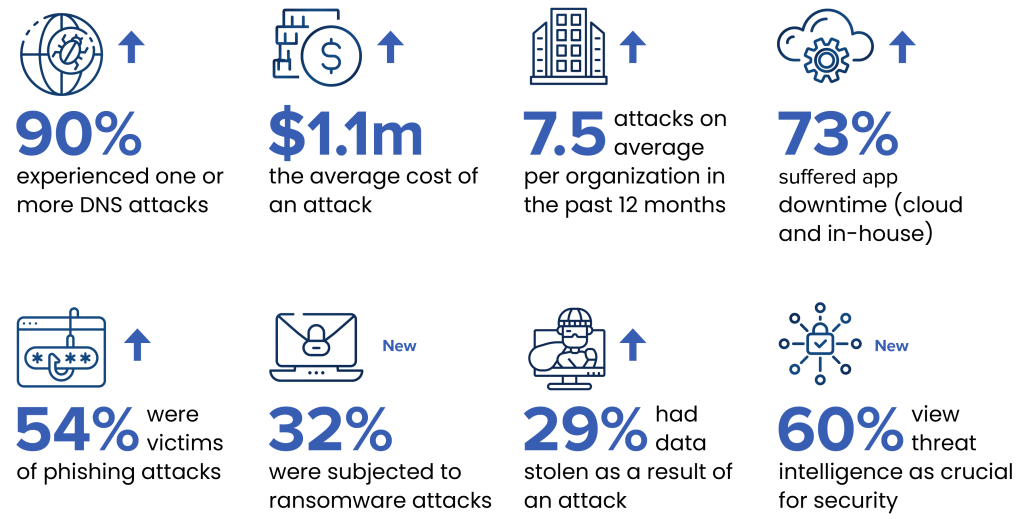
DNS (Domain Name System) is the internet’s directory service: it translates domain names like yoursite.com into the IP addresses that route network traffic. Every internet connection starts with a DNS query, making DNS one of the most exploited enterprise attack surfaces. According to the 2023 Global DNS Threat Report by IDC, 90% of organizations experienced at least one DNS attack, at an average cost of $1.1 million USD per incident. The recommended action: implement DNSSEC for zone authentication, encrypted DNS protocols (DoH or DoT) for query privacy, behavioral monitoring to detect tunneling and exfiltration, and strict resolver access controls.
Quick Answer: Why Is DNS Security Critical for Enterprises?
DNS is critical infrastructure that most enterprises underprotect. Attackers exploit DNS to redirect users to malicious sites (spoofing), disrupt services (DDoS amplification), exfiltrate data invisibly (tunneling), and take over domains (hijacking). Because DNS queries often bypass perimeter firewalls unmonitored, a single DNS vulnerability can compromise an entire organization’s traffic. The four controls that address most enterprise DNS risk are: DNSSEC (authenticates responses), DoT or DoH (encrypts queries in transit), DNS traffic monitoring (detects tunneling and anomalies), and restricted resolver access (prevents amplification).
Role of DNS in Cybersecurity
DNS plays a pivotal role in cybersecurity because it sits at the entry point of nearly every internet interaction. Attackers target DNS infrastructure to redirect users to malicious websites, disrupt network traffic, infiltrate systems, and exfiltrate data. DNS spoofing or cache poisoning leads users unknowingly to fraudulent websites, enabling phishing and malware delivery. DNS tunneling encodes data in DNS queries to bypass security measures. Domain hijacking redirects all traffic for a legitimate domain to attacker-controlled servers.
Organizations must monitor DNS requests continuously, as DNS itself cannot verify whether a domain points to legitimate or malicious content. The 2023 IDC data is notable: the average cost of a DNS attack rose from $942,000 in 2022 to $1.1 million in 2023, a 17% year-over-year increase. Phishing and ransomware remain the most common DNS attack vectors, typically resulting in application downtime or stolen data.
DNS Threat Model for Enterprises
| Attack type | How it works | Impact | Primary control |
|---|---|---|---|
| DNS Spoofing (Cache Poisoning) | Attacker injects false records into a resolver’s cache, redirecting users to malicious servers | Credential theft, malware delivery, phishing | DNSSEC on authoritative zones; resolver validation |
| DNS Amplification (DDoS) | Small queries to open resolvers return large responses directed at a victim, overwhelming bandwidth | Network congestion, service downtime | Restrict resolver to trusted sources; rate limiting; response rate limiting (RRL) |
| DNS Tunneling | Data encoded in DNS query and response strings to exfiltrate data or reach C2 servers | Data exfiltration, command-and-control communication | DNS traffic analytics; anomaly detection on query length and frequency |
| Domain Hijacking | Attacker compromises DNS registrar account or exploits registrar vulnerability to redirect all domain traffic | Full traffic redirection, credential theft, reputation damage | Registrar MFA; registry lock on critical domains; monitoring for unauthorized NS changes |
| Misconfigured DNS | Exposed zone transfers, open resolvers, or permissive DDNS allow information leakage or unauthorized changes | Information leakage, unauthorized DNS record modification | Restrict zone transfers to authorized secondaries; close open resolvers; audit DDNS permissions |
| DDNS Misuse | Dynamic DNS services abused to rapidly change IPs for botnet infrastructure or malware hosting | Malware and ransomware spread | Outbound DNS filtering; block known DDNS providers not in use; behavioral monitoring |
DNS Vulnerabilities
1. DNS Spoofing (Cache Poisoning)
Attackers manipulate DNS cache records by injecting false data into a resolver’s cache. Victims believe they are visiting a legitimate site while being redirected to a malicious server. Notable incidents: widespread DNS spoofing against Indian users (2023), disruption of Middle Eastern banks (2018), and a voter fraud attack in France (2015).
2. DNS Amplification Attacks
Attackers exploit open DNS resolvers to amplify small queries into large responses directed at a victim, overwhelming its bandwidth in a DDoS attack. Notable incidents: a novel DDoS attack in 2023, major attacks against cloud providers in 2020, and the GitHub attack of 2018.
3. DNS Tunneling
DNS is used covertly to transfer data or communicate with command-and-control servers. Attackers encode data in DNS queries and responses to bypass traditional security measures that focus on HTTP or direct outbound connections. Notable incidents: the APT34 attack on U.S. government networks (2021) and the Shamoon malware campaign against Iranian industrial systems (2020).
4. Misconfigured DNS Settings
Improperly configured DNS servers expose sensitive information, enable unauthorized access, or leave organizations vulnerable to attacks. Common misconfigurations include open zone transfers, open recursive resolvers, and overly permissive DDNS write access.
5. Domain Hijacking
Attackers gain unauthorized control of a domain by compromising registrar accounts or exploiting registrar vulnerabilities, then redirect all traffic. Notable incidents: hijacking of Sony’s domain (2021), hijacking of Tencent’s qq.com (2019), and the Twitter domain attack (2015).
6. Dynamic DNS (DDNS) Misuse
DDNS services that allow frequent IP updates are abused by attackers to host malicious content or facilitate botnet activity. The Mirai botnet’s DDNS exploitation in 2014 demonstrated the scale of damage achievable through this vector.
Protocol and Algorithm Selection for DNS Security
| Protocol/control | What it does | Best for | Limitations |
|---|---|---|---|
| DNSSEC | Cryptographic signatures on DNS records authenticate responses and prevent cache poisoning | All authoritative zones; especially critical for public-facing domains | Does not encrypt queries (responses can be observed); requires key management for zone signing keys (ZSK) and key signing keys (KSK); signing adds response size overhead |
| DNS over TLS (DoT) | Encrypts DNS queries between client and resolver using TLS on port 853 | Enterprise internal networks where DNS traffic monitoring is required | Dedicated port 853 is identifiable and can be filtered by upstream firewalls; requires resolver support |
| DNS over HTTPS (DoH) | Encrypts DNS queries inside HTTPS connections on port 443 | End-user privacy; environments where DoT is blocked | Harder to monitor at network level; can bypass enterprise DNS filtering if clients use external DoH resolvers |
| Response Rate Limiting (RRL) | Limits rate at which resolvers respond to queries from a single source, mitigating amplification | All recursive resolvers accessible from the internet | May affect legitimate high-volume queries; requires tuning |
| DNS RPZ (Response Policy Zone) | Allows resolver to override DNS responses for known-malicious domains | Enterprise recursive resolvers for threat intelligence integration | Depends on threat feed quality; known-bad domains only; zero-day domains bypass it |
Mitigation Strategies
1. Implement DNSSEC
DNSSEC adds cryptographic signatures to DNS records, enabling resolvers to verify that responses have not been tampered with. Zone owners sign DNS records with a private Zone Signing Key (ZSK); the public key is published in DNS, and resolvers verify the chain of trust back to the DNS root. DNSSEC prevents cache poisoning and spoofing but requires ongoing key management: ZSKs typically rotate every 30 to 90 days, and Key Signing Keys (KSKs) annually. Automate this rotation to prevent gaps in DNSSEC coverage.
2. Use Encrypted DNS Protocols (DoH or DoT)
Encrypting DNS traffic prevents eavesdropping and manipulation of queries in transit. DoT (DNS over TLS) on port 853 is the enterprise-recommended choice because it can be monitored and filtered at the network level without disrupting HTTPS visibility. DoH (DNS over HTTPS) is better for end-user privacy but makes DNS traffic harder for enterprise security teams to inspect. Both use TLS for transport security; the choice depends on whether network-level monitoring of DNS traffic is required.
3. Monitor DNS Traffic for Anomalies
DNS tunneling, data exfiltration, and command-and-control communication all produce observable patterns in DNS traffic: unusually long domain names, high query rates to unfamiliar domains, large TXT record responses, and queries to domains with no web presence. Establish baseline DNS traffic patterns and alert on statistical deviations. This is especially important because tunneling operates within legitimate DNS protocol, making it invisible to tools that only inspect application-layer traffic.
4. Restrict Public Access to DNS Resolvers
Open DNS resolvers are exploited for amplification attacks, where small queries produce large responses directed at victims. Configure recursive resolvers to accept queries only from trusted IP ranges (internal network segments and authorized clients). Never expose an internal recursive resolver to the public internet without strict access controls and rate limiting. Audit resolver configurations quarterly to verify access control lists remain correctly scoped.
Deployment Example: Enterprise DNS Security Program
A financial services organization with 5,000 employees and 120 public-facing domains implements a structured DNS security program:
- DNSSEC rollout for all public domains: zone signing keys (ZSK) are rotated every 60 days; key signing keys (KSK) annually. Automated ZSK rotation via the DNS management platform prevents signing gaps.
- Internal recursive resolvers: all internal resolvers are locked to accept queries only from internal RFC 1918 address ranges. Response rate limiting is configured. Resolvers are configured to validate DNSSEC for all queries.
- DoT for internal client DNS: all workstations and servers send DNS queries to internal resolvers over DoT. The dedicated port 853 allows the security team to monitor all DNS traffic volume and flag anomalies without disrupting HTTPS visibility.
- DNS traffic analytics: a behavioral analytics platform ingests DNS logs. Baseline query rates per host are established. Alerts trigger on query rates exceeding 300 per minute, on domain names longer than 50 characters, and on queries to newly registered domains with no web presence.
- Code signing for DNS software updates: updates to DNS resolver software and BIND configurations are signed using CodeSign Secure, preventing attackers from injecting malicious code into DNS system updates through the software supply chain.
- Registry lock on critical domains: the organization’s primary domain names are registry-locked with their registrar, requiring an out-of-band process to make NS record changes. This prevents domain hijacking even if registrar credentials are compromised.
How Encryption Consulting Can Help
Encryption Consulting provides specialized services that directly address the cryptographic dimensions of DNS security:
- Encryption Advisory Services: our Encryption Advisory Services assess DNS encryption configurations, DNSSEC implementation quality, and alignment with FIPS 140-2/3 standards for government and defense sectors where cryptographic compliance is mandatory.
- CodeSign Secure: securing updates to DNS servers and resolver software is critical. Our CodeSign Secure ensures DNS software updates are cryptographically signed, preventing attackers from injecting malicious code into DNS infrastructure through the software supply chain.
- CertSecure Manager: DNSSEC zone signing keys and DoT/DoH certificates are machine identities with lifecycle management requirements. CertSecure Manager tracks and automates renewal to prevent signing gaps that leave zones unprotected.
- Compliance Advisory: for organizations subject to NIST, DORA, or NIS2, our Compliance Advisory Services map DNS security controls to framework requirements and identify gaps.
Conclusion
DNS is foundational infrastructure that most enterprises underprotect relative to the risk it represents. It is one of the most exploited vectors for phishing, ransomware delivery, data exfiltration, and service disruption, and the cost of DNS attacks has grown every year. The four controls that address most enterprise DNS risk are DNSSEC for zone authentication, encrypted DNS protocols (DoT for enterprise networks, DoH for end users) for query privacy, behavioral traffic monitoring for anomaly detection, and restricted resolver access to prevent amplification. None of these controls is complex to implement in isolation; the challenge is consistent deployment across all zones and resolvers. As part of a broader enterprise encryption policy, robust DNS security practices are essential for defending against a wide range of cyber threats.
Frequently Asked Questions
What is DNS and why is it a security target?
DNS translates domain names into IP addresses, routing every internet connection. Every connection starts with a DNS query, making DNS a universal chokepoint. Attackers exploit it to redirect users, exfiltrate data, or disrupt services because DNS is widely trusted and often inadequately monitored.
What is DNSSEC and how does it work?
DNSSEC adds cryptographic signatures to DNS records. Zone owners sign records with a private key; resolvers verify with the public key. This prevents spoofing and cache poisoning. DNSSEC does not encrypt queries; it only authenticates responses. Encryption requires DoH or DoT.
What is the difference between DoH and DoT?
Both encrypt DNS queries to prevent eavesdropping. DoT uses a dedicated TLS connection on port 853, making it easier to monitor at the network level. DoH sends queries inside standard HTTPS on port 443, making DNS traffic indistinguishable from web traffic. Enterprises typically prefer DoT for monitoring visibility; end users often prefer DoH for privacy.
What is DNS tunneling and how is it detected?
DNS tunneling encodes data in DNS queries and responses to bypass firewalls. Detection relies on behavioral analytics: unusually long domain names, high query rates, large TXT record responses, and queries to domains with no web presence are all indicators. Baseline normal DNS traffic and alert on statistical deviations.
What DNS security protocols should enterprises implement?
DNSSEC for zone signing; DoT for encrypted internal DNS queries; response rate limiting on public-facing resolvers to mitigate amplification; and DNS traffic monitoring with behavioral analytics for tunneling detection. Restrict recursive resolvers to trusted source IP ranges only.
How much do DNS attacks cost enterprises?
The 2023 IDC Global DNS Threat Report found 90% of organizations experienced at least one DNS attack, at an average cost of $1.1 million USD per incident. Phishing and ransomware delivered via DNS vectors were the most common, causing application downtime and data theft.
- Quick Answer: Why Is DNS Security Critical for Enterprises?
- Role of DNS in Cybersecurity
- DNS Threat Model for Enterprises
- DNS Vulnerabilities
- Protocol and Algorithm Selection for DNS Security
- Mitigation Strategies
- Deployment Example: Enterprise DNS Security Program
- How Encryption Consulting Can Help
- Conclusion
- Frequently Asked Questions