
- Quick Answer: What Is a Cloud HSM and When Do You Need One?
- What Is a Hardware Security Module (HSM)?
- Cloud HSM vs Cloud KMS: Which Is Right for Your Workload?
- Cloud HSM Use Cases
- Deployment Topology
- Key Ceremony for Cloud HSMs
- High Availability and Backup
- Failure-Mode Guidance
- Integration Prerequisites
- Limitations of Cloud HSMs
- How Encryption Consulting Can Help
- Conclusion
- Frequently Asked Questions
A cloud HSM (Hardware Security Module as a Service) provides FIPS 140-2 or FIPS 140-3 validated cryptographic key protection via a vendor-managed, remotely accessible hardware appliance. It delivers the root-of-trust guarantees of physical HSM hardware without requiring organizations to purchase, colocate, and operate HSM appliances themselves. Cloud HSMs are the right choice when the risk profile demands hardware boundary protection for key material and when excluding the cloud provider from key access is a security requirement. The recommended action: identify which workloads require hardware key custody versus cloud KMS, validate the FIPS 140 level of the specific hardware appliance (not just the service), design for high availability across multiple HSM instances, and establish a key ceremony process for CA root and HSM master keys before production deployment.
Quick Answer: What Is a Cloud HSM and When Do You Need One?
A cloud HSM is a remotely accessible, FIPS-validated hardware appliance where cryptographic operations happen inside tamper-resistant hardware and key material never leaves the hardware boundary in plaintext. It differs from a cloud KMS (software-based key service): a KMS is convenient and cost-effective for most data-at-rest encryption, but the cloud provider can in principle access key material. A cloud HSM excludes the provider from key access and provides FIPS 140 hardware attestation. Use a cloud HSM for CA private keys, payment HSM functions, code signing keys, and any scenario requiring hardware root of trust with a FIPS boundary the provider cannot cross.
What Is a Hardware Security Module (HSM)?
Hardware Security Modules (HSMs) are purpose-built cryptographic processors that generate, store, and use encryption keys inside a tamper-resistant hardware boundary. The HSM is the centralized root of trust: cryptographic operations happen inside the boundary, and private keys never leave it in plaintext. HSMs are validated under FIPS 140-2 or the current FIPS 140-3 standard, with validation levels ranging from Level 1 (basic algorithm and equipment requirements) through Level 4 (active tamper response). Most enterprise security workloads use FIPS 140-2 Level 2 or Level 3 HSMs.
On-premises HSMs are highly secure but operationally complex: they require physical rack space, power, network connectivity, firmware management, and trained operators. In multi-cloud environments, deploying on-premises HSMs for each cloud region creates significant cost and operational overhead. Cloud HSMs address this by providing HSM-level security through a service model.
Cloud HSM vs Cloud KMS: Which Is Right for Your Workload?
| Dimension | Cloud KMS | Cloud HSM |
|---|---|---|
| Key storage | Software-protected key store; may use shared HSM hardware underneath | Dedicated hardware boundary; keys never in software |
| FIPS 140 validation | Varies by provider; software layer may not have hardware validation | FIPS 140-2 Level 2 or 3 (or FIPS 140-3); validated for the specific hardware appliance |
| Provider key access | Provider can in principle access key material (shared responsibility) | Customer-managed keys; provider cannot access key material in plaintext |
| Use cases | Data at rest encryption (database, storage, backups) for most workloads | CA root keys, code signing keys, payment HSM, TLS private keys requiring hardware custody |
| Performance | High throughput; software-based operations scale elastically | Lower throughput per appliance; scale by adding HSM instances in cluster |
| Cost | Low; typically per-key or per-operation pricing | Higher; typically per-hour per HSM instance |
| Compliance | Adequate for most commercial compliance frameworks | Required for PCI HSM, some government regulations, and workloads requiring hardware attestation |
Cloud HSM Use Cases
- TLS private key protection: web servers present TLS certificates to authenticate to clients. The private key behind the certificate must be protected; if extracted, an attacker can impersonate the server or decrypt recorded sessions. A cloud HSM generates the private key inside the hardware boundary and performs TLS operations (handshake signing) within the HSM, so the private key never exists outside the hardware.
- Certificate authority (CA) root and intermediate key storage: CA private keys are the most sensitive keys in a PKI hierarchy. A compromised CA private key enables an attacker to issue certificates for any domain in the CA’s trust scope. Cloud HSMs protect CA keys with hardware custody and controlled access, supporting the key ceremony process required for new CA establishment.
- Code signing key protection: code signing private keys authorize software releases. If stolen, the key can be used to sign malware that appears legitimate to end-user devices. A cloud HSM ensures signing operations occur inside hardware and signing key material cannot be exported.
- Database encryption key management: database encryption uses a key hierarchy: data encryption keys (DEKs) encrypt individual tables or columns; key encryption keys (KEKs) wrap the DEKs. The KEK is the highest-value key and belongs in an HSM. The cloud HSM holds the KEK; DEKs are unwrapped by the HSM on demand.
- IoT device provisioning: during manufacturing, each IoT device receives a unique certificate and private key for device authentication. The issuing CA private key should be HSM-protected to ensure device identities cannot be forged at scale.
- Payment HSM functions: payment processing requires hardware-protected operations for PIN block encryption, EMV cryptogram generation and verification, and payment key loading. Cloud-accessible payment HSMs allow organizations to use hardware-based payment security without on-premises payment HSM hardware.
Deployment Topology
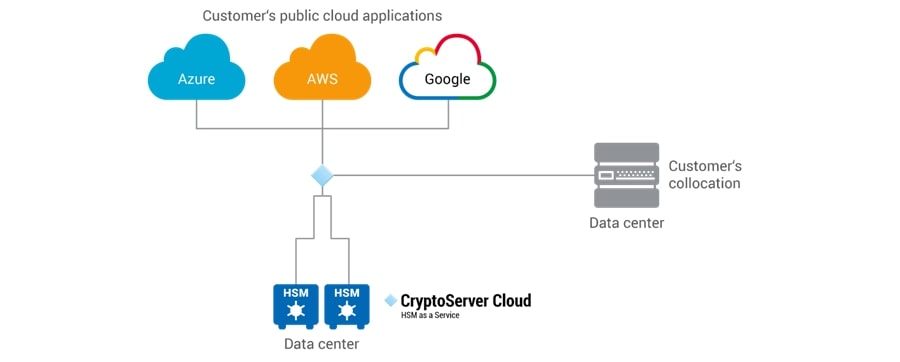
- Single-region: one HSM cluster in a single cloud region. Suitable for development, testing, and workloads where the region itself provides sufficient availability. Single region does not provide geographic redundancy; a full region outage affects all HSM operations.
- Multi-region active-active: HSM clusters in two or more regions with key material replicated across regions. Applications route to the nearest available cluster. If one region becomes unavailable, traffic shifts to the remaining regions. This provides geographic redundancy but requires key replication mechanisms and consistency management across regions.
- Hybrid (cloud + on-premises): an on-premises HSM is the primary key store for the most sensitive keys (CA root), with cloud HSMs handling operational workloads that need lower-latency access in cloud environments. Key replication from on-premises to cloud HSMs uses the HSM’s backup encryption mechanism.
Key Ceremony for Cloud HSMs
A key ceremony is the controlled, audited process for establishing the highest-sensitivity keys: CA root keys, HSM administrator credentials, and key encryption keys. For cloud HSMs, key ceremonies may occur at the cloud provider’s data center with customer witnesses, or remotely using the HSM’s quorum authentication mechanism (M-of-N authorization, where M of N designated custodians must authenticate to perform sensitive operations).
A typical cloud HSM key ceremony includes: verifying the HSM’s FIPS validation status and attestation certificate; establishing HSM administrator credentials using M-of-N quorum smartcards; generating the HSM master key (or key wrapping key) inside the hardware boundary; creating a key backup encrypted by the HSM’s backup key; splitting the backup authorization across M-of-N custodians using secret sharing; and producing a signed audit record of all ceremony actions.
High Availability and Backup
- HSM cluster replication: cloud HSM services maintain clusters of at least two appliances per availability zone, with key material synchronized across the cluster. If one appliance fails, the cluster continues operating from the surviving appliances with no key loss.
- Key backup and restore: HSMs generate encrypted backups of all key material. The backup is encrypted by the HSM’s own backup key, which is itself protected by the HSM and only restorable to an HSM of the same validated type. Backup credentials are split across custodians using quorum authorization.
- Cross-region restore time objective: organizations must test cross-region restore of HSM key material. Unverified backups that cannot be restored in time are a common failure mode in disaster recovery plans.
Failure-Mode Guidance
- HSM appliance failure: single-appliance failure is handled by the cluster. If the entire cluster fails and no cross-region backup exists, all operations requiring HSM private keys (TLS handshakes, signing, decryption) will fail. Mitigation: maintain at least two HSM clusters in different availability zones.
- Lost quorum credentials: if M-of-N custodians for HSM administrator credentials are unavailable (custodian turnover, lost smartcards), the HSM cannot be administered. Mitigation: maintain current smartcard inventory; assign backup custodians; test quorum recovery procedures annually.
- Expired certificates on HSM-backed keys: TLS certificates backed by HSM private keys will expire even though the private key remains valid. An expired certificate causes connection failures. Mitigation: use automated certificate lifecycle management for all HSM-backed TLS certificates. See CertSecure Manager.
- Cloud provider HSM service deprecation: cloud providers occasionally deprecate HSM service offerings. Key material must be exportable in encrypted form to allow migration to a new service. Verify key export capabilities and test them before production deployment.
Integration Prerequisites
- PKCS#11 or JCE interface support: applications must interface with the HSM through a standard cryptographic API (PKCS#11, Java Cryptography Extension (JCE), or Microsoft CNG). Verify the application’s cryptographic library supports the cloud HSM’s interface before selecting the service.
- Network connectivity and latency: cloud HSMs are accessed over the network. TLS handshakes that require HSM private key operations add one network round-trip to the handshake latency. For high-frequency, latency-sensitive operations (TLS termination at high request rates), this latency impact must be tested and acceptable.
- Key import versus generation: cloud HSMs can either generate keys internally (preferable; the key material never exists outside the hardware) or import externally generated keys (the import process must wrap the key using the HSM’s public import key before transmission; the plaintext key must only ever exist in another FIPS-validated HSM during import).
Limitations of Cloud HSMs
- Higher latency than on-premises HSM: network round-trips add latency to HSM operations. For workloads performing thousands of signing operations per second, on-premises HSMs may be required to meet performance requirements.
- Vendor dependency: key material encrypted by a specific cloud HSM model may only be restorable to the same HSM type. Evaluate key portability and ensure backup material can be restored to an alternative if the provider discontinues the service.
- Physical custody is with the provider: unlike on-premises HSMs where the organization controls physical access, cloud HSMs rely on the provider’s data center security controls. Verify the provider’s FIPS 140 certification documentation and audit reports.
- Post-quantum readiness: current cloud HSMs support RSA and ECC cryptography, both of which will be vulnerable to quantum computers. Cloud HSM providers will need to add support for NIST-standardized post-quantum algorithms (ML-KEM, ML-DSA). Plan for algorithm migration as PQC-capable HSM services become available.
How Encryption Consulting Can Help
Encryption Consulting’s HSM as a Service provides FIPS 140-3 validated hardware security module infrastructure for organizations that need hardware-rooted key protection without the overhead of managing HSM hardware themselves. Our HSM as a Service offering supports PKI deployments, code signing pipelines, TLS private key protection, and key ceremony services. Key capabilities include:
- FIPS 140-3 validated hardware with customer-controlled key material
- Support for PKCS#11 and other standard cryptographic interfaces
- High availability configurations across multiple appliances
- Key ceremony services with documented audit trails
- Integration with CertSecure Manager for automated TLS certificate lifecycle management on HSM-backed keys
- Integration with PKI as a Service for hardware-backed CA deployments
For organizations assessing whether their workloads require a cloud HSM or cloud KMS, our Encryption Advisory Services provide workload analysis, FIPS requirement mapping, and architecture recommendations. We also help with cloud-to-cloud or on-premises-to-cloud HSM migrations, including key export, transfer, and re-import procedures. See our related post on Cloud-based vs On-premises HSMs for a detailed comparison.
Conclusion
Cloud HSMs bring hardware-rooted key protection to cloud workloads without requiring organizations to manage physical HSM hardware. They are the right choice for CA private keys, payment HSM functions, code signing keys, and any scenario where the cloud provider must be excluded from key access and where FIPS 140 hardware attestation is required. The key design decisions are FIPS validation level (verify the hardware appliance, not just the service), deployment topology (single-region, multi-region, or hybrid), high availability configuration (cluster replication and cross-region backup), and key ceremony procedures for establishing the highest-sensitivity keys. Cloud HSMs are not a replacement for cloud KMS in all scenarios: for most data-at-rest encryption, a well-configured KMS is adequate and significantly cheaper. Use the decision table above to map each workload to the right tool.
Frequently Asked Questions
What is a cloud HSM?
A FIPS 140-2 or FIPS 140-3 validated cryptographic hardware appliance operated by a provider and accessed remotely. Key material stays inside the hardware boundary; the provider cannot access keys in plaintext. Provides the root-of-trust guarantees of an on-premises HSM without requiring the customer to own or operate the hardware.
What is the FIPS 140 boundary and why does it matter?
The FIPS 140 boundary is the physical and logical perimeter within which cryptographic operations occur and keys are protected. Keys generated inside the boundary are never in plaintext outside it. FIPS 140-2 Level 2 is the minimum for most financial and government workloads; FIPS 140-3 is the current standard. Verify the validation applies to the specific hardware appliance, not just the software layer.
What is the difference between a cloud HSM and a cloud KMS?
A cloud KMS is software-based; the provider can in principle access key material. A cloud HSM uses dedicated hardware; the provider cannot access key material in plaintext. Use KMS for most data-at-rest encryption; use HSM for CA keys, payment HSM functions, code signing, and any workload requiring hardware boundary attestation or provider exclusion from key access.
What are the main use cases for cloud HSMs?
TLS private key protection, CA root and intermediate key storage, code signing key protection, database encryption key management (KEK protection), IoT device provisioning via hardware-rooted CA, and payment HSM functions (PIN block encryption, EMV key management).
How does high availability work for cloud HSMs?
Through HSM clusters with key material synchronized across multiple appliances. Single appliance failure is handled by the cluster. Cross-region HA requires replicating key material to HSM clusters in a second region using the HSM’s encrypted backup and restore mechanism.
What is a key ceremony and does it apply to cloud HSMs?
A key ceremony is a controlled, audited process for generating or importing the most sensitive keys (CA root, HSM master keys) with witnesses present. For cloud HSMs, it may occur at the provider’s data center with customer witnesses or remotely using M-of-N quorum authentication. The ceremony produces a signed audit record and splits administrator credentials across multiple custodians.
- Quick Answer: What Is a Cloud HSM and When Do You Need One?
- What Is a Hardware Security Module (HSM)?
- Cloud HSM vs Cloud KMS: Which Is Right for Your Workload?
- Cloud HSM Use Cases
- Deployment Topology
- Key Ceremony for Cloud HSMs
- High Availability and Backup
- Failure-Mode Guidance
- Integration Prerequisites
- Limitations of Cloud HSMs
- How Encryption Consulting Can Help
- Conclusion
- Frequently Asked Questions