

- Key Takeaways
- What Is DevSecOps?
- What Does Scaling DevSecOps Mean?
- Why Scaling DevSecOps Matters in 2026
- Benefits of Scaling DevSecOps
- Challenges in Scaling DevSecOps
- When Do You Need to Scale DevSecOps?
- How to Scale DevSecOps: Six Steps
- How Encryption Consulting Helps
- Frequently Asked Questions
- Secure Your Pipelines at Scale
DevSecOps scaling is the practice of extending automated security controls and shared security responsibility across a growing number of teams, pipelines, and environments, while expanding or shrinking security resources to match workload.
Scaling DevSecOps means embedding automated security controls, such as code scanning, dependency checks, secrets management, and code signing, into every CI/CD pipeline as an organization grows, and adjusting security tooling and infrastructure up or down as demand changes. The goal is consistent security coverage across all teams and applications without slowing delivery.
Key Takeaways
- DevSecOps embeds security into every stage of the DevOps lifecycle. Scaling it extends that coverage across more teams, applications, and environments as the organization grows.
- Automation is the only way to keep security consistent as release frequency rises. GitLab’s 2026 Global DevSecOps Survey of 3,266 professionals found that 82% of organizations now deploy to production at least weekly.
- US federal rules made secure pipelines a procurement issue: Executive Order 14028 (May 2021) led to NIST SP 800-218, the Secure Software Development Framework (February 2022), and OMB M-22-18 required federal software suppliers to self-attest to SSDF conformance until OMB M-26-05 (January 2026) moved agencies to risk-based software security requirements.
- Tool sprawl is the main scaling tax. In the same GitLab survey, 60% of organizations reported using more than five tools for software development.
- Code signing anchors artifact integrity at scale. Since June 1, 2023, the CA/Browser Forum has required publicly trusted code signing keys to be stored on hardware meeting at least FIPS 140-2 Level 2 or Common Criteria EAL 4+.
What Is DevSecOps?
DevSecOps is the practice of building security into every stage of the DevOps lifecycle instead of treating it as a final review gate.
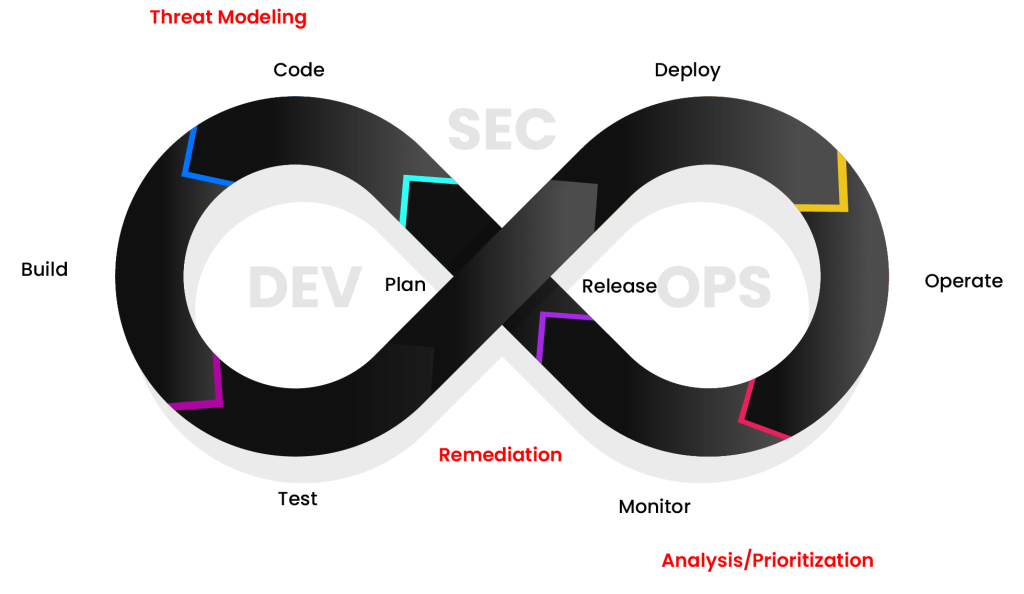
DevOps emerged around 2009 to close the gap between development and operations teams. It is usually drawn as an infinity loop of eight stages: Plan, Develop, Build, Test, Release, Deploy, Operate, and Monitor. The model made delivery fast, but security reviews stayed manual and late, so they became the bottleneck.
Security-first development predates the term. Microsoft formalized its Security Development Lifecycle (SDL) in 2004, requiring security activities in each phase of its own product development. The DevSecOps label took hold in 2015, when Shannon Lietz and colleagues at Intuit published the DevSecOps Manifesto at devsecops.org, arguing that security decisions should be distributed at speed and scale to the people with the most context. That idea became “shift left”: run security checks from the earliest design and coding stages rather than only before release.
Three shifts pushed the model into the mainstream: Waterfall giving way to Agile and DevOps, monoliths splitting into microservices, and data centers moving to the cloud. Each multiplied the number of things to secure, which is exactly the problem scaling addresses.
What Does Scaling DevSecOps Mean?
Scaling DevSecOps means keeping security coverage consistent as the number of teams, applications, pipelines, and environments grows, and adjusting security resources elastically as demand changes.
Scaling works in both directions. Expanding happens when deployment volume, security requirements, or team count rises: more scanner capacity, more compute for automated tests, more policy enforcement points. Shrinking happens when demand falls, for example after a major release, by releasing servers, containers, and licenses that are no longer needed. Cloud infrastructure makes both directions largely automatic, since virtual machines and containers can be allocated and reclaimed on demand.
A security control that runs in one pipeline is a tool. A control that runs in every pipeline is DevSecOps at scale.
Why Scaling DevSecOps Matters in 2026
Delivery speed, AI-generated code, and regulation have all outgrown manual security review.
GitLab’s ninth annual Global DevSecOps Survey, conducted by The Harris Poll among 3,266 professionals and released in November 2025 as its 2026 report, found that 82% of organizations deploy to production at least weekly, 60% use more than five tools for software development, and teams lose roughly seven hours per member each week to AI-related inefficiencies.
Respondents also reported that about 34% of their code is now AI-generated. Veracode’s 2025 GenAI Code Security Report, which tested over 100 large language models, found that 45% of AI-generated code samples failed security tests by introducing OWASP Top 10 vulnerabilities. More code from more sources means more automated checking, not less.
Regulation moved in the same direction. Executive Order 14028, Improving the Nation’s Cybersecurity (May 2021), tasked NIST with defining secure development guidance. The result, NIST SP 800-218, the Secure Software Development Framework (SSDF) v1.1, was published in February 2022, and OMB Memorandum M-22-18 made self-attestation to SSDF practices mandatory for software suppliers to the US federal government.
NIST extended the framework to AI development with SP 800-218A in July 2024. In January 2026, OMB Memorandum M-26-05 replaced the blanket attestation mandate with agency-led, risk-based software security requirements, keeping the SSDF as the reference framework. A DevSecOps program that covers only some pipelines cannot credibly demonstrate SSDF conformance under either policy.
Benefits of Scaling DevSecOps
The main benefits are earlier vulnerability detection, consistent compliance, and lower cost per fix.
- Earlier detection: Security checks in every stage catch flaws while they are cheap to fix, instead of after deployment. Static Application Security Testing (SAST) reviews source code; Dynamic Application Security Testing (DAST) probes the running application.
- Consistent compliance: Automated policy checks apply the same controls across every team, which supports frameworks such as HIPAA, GDPR, PCI DSS, and ISO 27001.
- Lower remediation cost: Fixing an issue found by a pipeline scanner costs a code change. Fixing the same issue in production can cost incident response, downtime, and penalties.
- Better resource utilization: Elastic scaling allocates scanner capacity and compute where the workload is, and releases it when the workload subsides.
- Faster delivery: Automated gates replace queued manual reviews, so feedback reaches developers in minutes. Netflix, for example, open-sourced Lemur, its certificate management framework, as part of automating security across its high-frequency delivery pipelines.
Challenges in Scaling DevSecOps
The hardest parts of scaling are tool sprawl, integration effort, and skills, not the security concepts themselves.
- Tool sprawl and integration: Every new scanner must plug into existing CI/CD systems. Overlapping tools overwhelm teams, a problem often called tool fatigue; 60% of organizations already run more than five development tools (GitLab, 2026).
- Automation investment: Replacing manual checks with reliable automation takes sustained engineering time before it pays back.
- Visibility and feedback: As systems multiply, collecting meaningful signals from monitoring and routing them to the right team gets harder.
- Compliance across environments: More microservices, cloud accounts, and regions mean more places where a control can silently be missing.
- Skills gaps: Scaling requires people fluent in CI/CD, containerization, and security automation. Without training or hiring, practices drift apart between teams.
- Deployment conflicts: More developers on the same codebase means more conflicting changes. Strong version control and code review policies keep merge conflicts from delaying releases.
When Do You Need to Scale DevSecOps?
Scale DevSecOps when security work stops keeping pace with delivery work. Six signals stand out:
- Rising exposure to supply chain attacks, code tampering, ransomware, insider threats, credential theft, or API abuse.
- An upward trend in production error rates or security defects escaping to release.
- A security team that has become the queue everyone waits on.
- Manual security checks or audits that consume days per release.
- A DevOps adoption program that has no matching plan for security automation.
- Multiple production deployments per day without automated security gates in each one.
How to Scale DevSecOps: Six Steps
Scale incrementally, one measured change at a time, in this order:
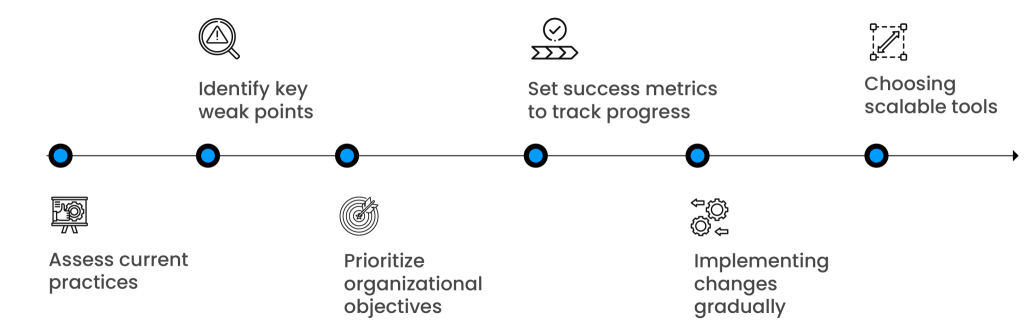
- Assess current practices: Map existing development and security processes. Identify coverage gaps, bottlenecks, and manual steps that slow the workflow.
- Identify the weak points: Ask what breaks first if workload doubles: error-prone code, overloaded reviewers, insecure defaults, or delayed deployments.
- Prioritize organizational objectives: Align scaling work with what the business needs most, whether that is deployment frequency, faster QA, or new feature delivery.
- Set success metrics: Define measurable goals, such as time from pull request to production or vulnerabilities caught before merge, and track them.
- Implement changes gradually: Roll out one change at a time, collect team feedback, and let it guide the next improvement. This limits disruption and surfaces hidden problems early.
- Choose scalable tools: Select tools designed to grow with team count and integrate with your existing pipeline rather than requiring constant manual adjustment.
| Tool | Category | Strengths |
| SonarQube | Static code analysis (SAST) | Multi-language support, strong community, CI/CD integration |
| Snyk | Dependency scanning (SCA) | Continuously updated vulnerability database, developer workflow integration |
| Aqua | Container security | Container runtime protection, Kubernetes integration |
| HashiCorp Sentinel | Policy as code (IaC security) | Enforces policy inside Terraform workflows, fine-grained controls |
| OWASP ZAP | Dynamic testing (DAST) | Free, open source, active scanning of running applications |
| HashiCorp Vault | Secrets management | Central secret storage, access controls, audit logging |
| Splunk SOAR (formerly Phantom) | Security orchestration, automation, and response | Playbook automation, scales for large teams |
How Encryption Consulting Helps
CodeSign Secure is Encryption Consulting’s enterprise code signing platform for DevSecOps pipelines. It automates signing inside CI/CD systems including GitHub Actions, Azure DevOps, Jenkins, GitLab, TeamCity, and Bamboo, with private keys held on HSMs, satisfying the certified hardware protection the CA/Browser Forum has required for publicly trusted code signing since June 1, 2023. Built-in SAST and Software Composition Analysis (SCA) scanning, plus SonarQube integration, block signing when vulnerabilities are detected, and reproducible builds with pre- and post-hash validation confirm artifact integrity from build to release. Every signing operation is logged for audit. Backed by ISO/IEC 27001:2022 and SOC 2 certified practices.
Frequently Asked Questions
What is DevSecOps scaling in simple terms?
DevSecOps scaling is the process of applying the same automated security checks to every team and pipeline in an organization, no matter how many there are. As the organization grows, security tooling and infrastructure expand with it; when demand drops, resources shrink back. The result is uniform security coverage without manual bottlenecks.
What is the difference between DevOps and DevSecOps?
DevOps combines development and operations to deliver software quickly through automation and continuous feedback. DevSecOps adds security as a shared responsibility across that same lifecycle, embedding controls such as static analysis, dependency scanning, and code signing directly into CI/CD pipelines. In DevOps, security often sits as a separate final gate; in DevSecOps, it runs continuously from design to production.
Which tools are used to scale DevSecOps?
Common tools include SonarQube for static code analysis, Snyk for dependency scanning, Aqua for container security, OWASP ZAP for dynamic testing, HashiCorp Vault for secrets management, HashiCorp Sentinel for policy as code, and Splunk SOAR for security automation. Signing platforms such as CodeSign Secure protect build artifacts. Choose tools that integrate with your existing CI/CD systems and hold up as teams multiply.
What regulations and policies drive DevSecOps adoption?
US Executive Order 14028 (May 2021) directed NIST to define secure development practices, which became the Secure Software Development Framework in NIST SP 800-218 (February 2022). OMB Memorandum M-22-18 required SSDF self-attestation from federal software suppliers until OMB M-26-05 (January 2026) shifted agencies to risk-based requirements. Sector rules such as PCI DSS, HIPAA, and GDPR also mandate security controls that scaled DevSecOps pipelines help enforce.
How does code signing fit into scaled DevSecOps?
Code signing proves that a build artifact came from a trusted pipeline and has not been altered since it was signed. In a scaled DevSecOps program, signing runs automatically in CI/CD, with private keys held in certified hardware such as HSMs, which the CA/Browser Forum has required for publicly trusted code signing since June 1, 2023. This blocks tampered artifacts from reaching production or customers.
Secure Your Pipelines at Scale
Ready to make signing and scanning automatic in every pipeline? Explore CodeSign Secure, or talk to an Encryption Consulting advisor.
- Key Takeaways
- What Is DevSecOps?
- What Does Scaling DevSecOps Mean?
- Why Scaling DevSecOps Matters in 2026
- Benefits of Scaling DevSecOps
- Challenges in Scaling DevSecOps
- When Do You Need to Scale DevSecOps?
- How to Scale DevSecOps: Six Steps
- How Encryption Consulting Helps
- Frequently Asked Questions
- Secure Your Pipelines at Scale