
- Quick Answer: Which Encryption Algorithm Should Your Organization Use?
- Encryption Algorithm Comparison
- Performance: What Matters in Practice
- AES: The Standard for Symmetric Encryption
- Algorithm Selection: Which to Use for Which Use Case
- Deployment Example: Multi-Layer Encryption in a Financial Services Environment
- Key Management: The Real Determinant of Encryption Effectiveness
- Limitations and Trade-offs
- Conclusion
- Frequently Asked Questions
Encryption algorithm selection determines the strength of your data protection: the wrong choice can leave data vulnerable to brute-force attacks, known cryptanalytic weaknesses, or future quantum computing threats. Data encryption converts plaintext into ciphertext that only authorized parties with the correct key can read. The recommended action: use AES-256-GCM for data at rest, TLS 1.3 with ECDHE for data in transit, ECC P-256 or RSA-3072 for asymmetric operations, and avoid DES and 3DES in all new deployments. Key management, not the algorithm itself, is the most common failure point in encryption implementations.
Quick Answer: Which Encryption Algorithm Should Your Organization Use?
The algorithm depends on the data protection use case. For data at rest, use AES-256-GCM: fast, NIST-recommended, and provides authenticated encryption that detects tampering in addition to encrypting. For data in transit, use TLS 1.3 with AES-256-GCM or ChaCha20-Poly1305 cipher suites and ECDHE key exchange for forward secrecy. For digital signatures and certificates, use ECDSA P-256 (preferred for new deployments due to smaller key size and faster operations) or RSA-3072 (minimum; RSA-2048 is the absolute minimum and is proposed for deprecation after 2030 per NIST IR 8547). Avoid DES (56-bit key, broken), 3DES (formally deprecated by NIST for new applications in 2019, Sweet32 vulnerability), RC4, and MD5. For post-quantum readiness, plan migration of asymmetric algorithms to ML-KEM (FIPS 203) and ML-DSA (FIPS 204).
Encryption Algorithm Comparison
The table below compares the most commonly encountered encryption algorithms across the dimensions that matter for security decision-making. This blog’s distinct focus is operational selection guidance: which algorithm for which use case, and why, with explicit NIST compliance status for each.
| Algorithm | Type | Key size | Security strength | Speed | NIST status | Use for |
|---|---|---|---|---|---|---|
| AES-128-GCM | Symmetric block cipher (AEAD) | 128 bits | 128-bit (post-quantum: ~64-bit) | Very fast (hardware accelerated) | Approved; FIPS 197 | Data at rest, TLS session encryption |
| AES-256-GCM | Symmetric block cipher (AEAD) | 256 bits | 256-bit (post-quantum: ~128-bit) | Fast (hardware accelerated) | Approved; FIPS 197; CNSA 2.0 required for national security | Data at rest, data in transit, highest-sensitivity data |
| ChaCha20-Poly1305 | Symmetric stream cipher (AEAD) | 256 bits | 256-bit | Very fast (no hardware acceleration needed) | Approved; used in TLS 1.3 | TLS session encryption; mobile and IoT where AES-NI unavailable |
| RSA-2048 | Asymmetric (public key) | 2048-bit modulus | 112-bit | Slow for signing; fast for verification | Approved through 2030; proposed deprecated after 2030 per NIST IR 8547 | TLS certificates, key exchange (legacy); code signing (minimum) |
| RSA-3072 | Asymmetric (public key) | 3072-bit modulus | 128-bit | Slower than RSA-2048 | Approved; recommended for new RSA deployments | New RSA-based certificate and signature infrastructure |
| ECDSA P-256 | Asymmetric (elliptic curve) | 256-bit point | 128-bit | Fast | Approved; FIPS 186-5 | TLS certificates, code signing, digital signatures (preferred over RSA-3072 for new deployments) |
| 3DES (Triple DES) | Symmetric block cipher | 168-bit nominal (112-bit effective) | 112-bit effective (Sweet32 attack on 64-bit block size) | Slow | Deprecated for new applications (NIST SP 800-131A Rev. 2, 2019) | Legacy verification only; do not use for new encryption |
| DES | Symmetric block cipher | 56 bits | Less than 56-bit (exhaustive key search feasible) | Slow | Not approved; disallowed | Do not use |
Performance: What Matters in Practice
Algorithm performance is relevant but is rarely the primary decision factor for most organizations. Modern processors with AES-NI (AES Native Instructions) hardware acceleration run AES-256-GCM fast enough that algorithm performance is typically not a bottleneck for data encryption at rest or in transit, even at high throughput. The performance dimensions that do matter in practice:
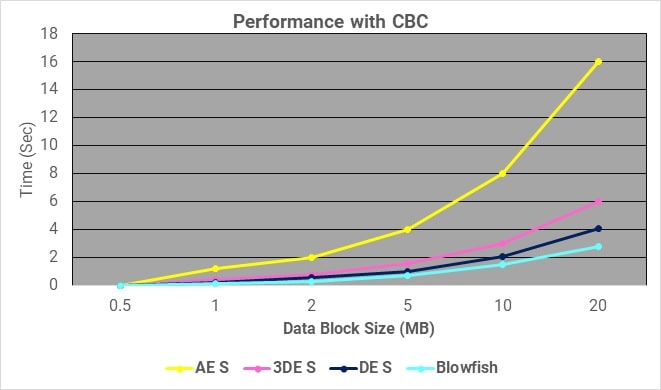
- Symmetric encryption (AES-256-GCM vs. ChaCha20-Poly1305): on hardware with AES-NI, AES-256-GCM is typically faster. On mobile or IoT hardware without AES-NI, ChaCha20-Poly1305 is significantly faster. TLS 1.3 supports both and negotiates based on client and server capability.
- Asymmetric operations (RSA vs. ECC): RSA verification (public key operation) is fast; RSA signing (private key operation) is slow. ECDSA P-256 signing is significantly faster than RSA-3072 signing at equivalent security strength, which matters for high-throughput code signing or certificate issuance. ECDSA verification is slightly slower than RSA verification.
- Key size impact on storage and bandwidth: an RSA-3072 certificate is approximately 6 times larger than an ECDSA P-256 certificate at equivalent security. For DNSSEC (where responses must fit in UDP packets) and mobile applications (where bandwidth and latency matter), ECC key sizes significantly reduce overhead.
AES: The Standard for Symmetric Encryption
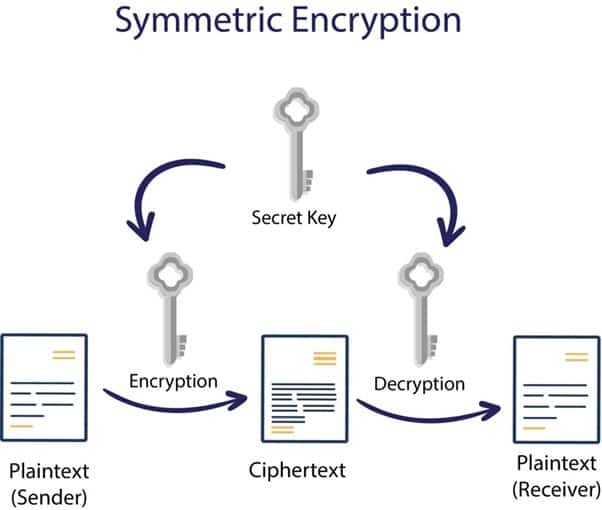
AES (Advanced Encryption Standard) was selected by NIST in 2001 following a public competition and is defined in FIPS 197. It is the universally accepted standard for symmetric encryption in government, financial services, healthcare, and most other industries. AES is a block cipher that processes 128-bit blocks using substitution-permutation operations applied in rounds:
| Key size | Rounds | Security strength | Use case |
|---|---|---|---|
| 128 bits | 10 | 128-bit (~64-bit post-quantum with Grover’s) | Standard data encryption; TLS session keys |
| 192 bits | 12 | 192-bit | Classified information at the “Secret” level (US government) |
| 256 bits | 14 | 256-bit (~128-bit post-quantum with Grover’s) | Highest-sensitivity data; CNSA 2.0 requirement; default recommendation for new deployments |
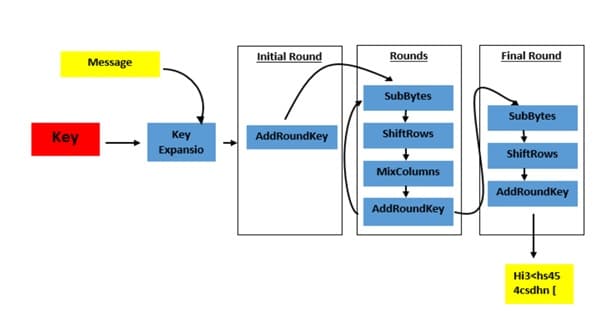
The AES encryption process consists of four operations applied in each round: SubBytes (non-linear byte substitution using the S-Box), ShiftRows (cyclic byte shifting within rows of the 4×4 state matrix), MixColumns (linear mixing across columns for diffusion), and AddRoundKey (XOR with the round key derived from the cipher key). The final round omits MixColumns. Decryption applies the inverse of each operation in reverse order.
Algorithm Selection: Which to Use for Which Use Case
| Use case | Recommended algorithm | Avoid | Reference |
|---|---|---|---|
| Data at rest (databases, file systems, backups) | AES-256-GCM | DES, 3DES, AES-ECB (no integrity), AES-CBC without MAC | NIST SP 800-111; FIPS 197 |
| Data in transit (TLS) | TLS 1.3 with AES-256-GCM or ChaCha20-Poly1305; ECDHE key exchange | SSL 3.0, TLS 1.0/1.1, RC4, 3DES cipher suites | NIST SP 800-52 Rev. 2 |
| Digital signatures and certificates | ECDSA P-256 (preferred) or RSA-3072 (minimum for new RSA); RSASSA-PSS for RSA | RSA-1024, RSA-2048 for new long-lived infrastructure, DSA | NIST FIPS 186-5; NIST IR 8547 |
| Key exchange / encapsulation | ECDH P-256 or X25519; post-quantum: ML-KEM (FIPS 203) | RSA key exchange (no forward secrecy); static DH | NIST SP 800-56A Rev. 3; FIPS 203 |
| Hashing (integrity, signatures) | SHA-256 or SHA-384 | MD5, SHA-1 (both broken for collision resistance) | NIST FIPS 180-4; NIST SP 800-131A |
| Mobile and IoT (no AES-NI hardware) | ChaCha20-Poly1305 for encryption; Ed25519 for signatures | DES, RC4, weak cipher suites | RFC 8439 (ChaCha20-Poly1305); RFC 8032 (Ed25519) |
| Post-quantum migration (asymmetric) | ML-KEM (FIPS 203) for key exchange; ML-DSA (FIPS 204) for signatures | RSA and ECC alone for new long-lived infrastructure | NIST FIPS 203, 204, 205; NIST IR 8547 |
Deployment Example: Multi-Layer Encryption in a Financial Services Environment
A financial services organization encrypting customer financial records and transaction data implements the following algorithm stack:
- Data at rest (database field encryption): AES-256-GCM with per-record encryption keys (DEKs). Each DEK is wrapped with a Key Encryption Key (KEK) stored in an HSM. The HSM performs key unwrapping operations inside the hardware; the KEK never enters application memory.
- Data at rest (full database encryption): AES-256-CBC with HMAC-SHA-256 (for compatibility with the database’s native encryption feature, which does not support GCM). Field-level AES-256-GCM is used for the highest-sensitivity fields (account numbers, SSNs) where per-record integrity verification is required.
- Data in transit (public-facing web applications): TLS 1.3 with AES-256-GCM cipher suite. ECDHE P-256 key exchange provides forward secrecy. TLS certificates use ECDSA P-256, reducing certificate size and TLS handshake time compared to RSA-2048 certificates.
- Data in transit (internal service-to-service APIs): mutual TLS (mTLS) with the same TLS 1.3 configuration. Both the client and server present ECDSA P-256 certificates, providing cryptographic authentication of both sides of the connection.
- Code signing for software releases: RSASSA-PSS with SHA-256 and RSA-3072, signing performed inside an HSM using CodeSign Secure. The signing private key never leaves the HSM.
- PQC planning: the organization’s cryptographic inventory (produced using CBOM Secure) identifies all RSA and ECC instances. A phased migration plan prioritizes long-lived certificate hierarchies and code signing infrastructure for migration to ML-DSA (FIPS 204) by 2027.
Key Management: The Real Determinant of Encryption Effectiveness
The strength of an encryption algorithm means nothing if the keys are compromised. An organization using AES-256-GCM with a key stored in a plaintext config file on the same server as the encrypted data has approximately the same real-world protection as using no encryption: any attacker who reads the encrypted data can also read the key. Key management best practices for organizational data encryption:
- Separate keys from encrypted data: encryption keys must not be stored in the same location as the data they protect. Use a dedicated key management service (KMS) or Hardware Security Module (HSM) to store and manage encryption keys. See HSM as a Service for hardware-backed key storage.
- Use envelope encryption: encrypt individual records or files with a Data Encryption Key (DEK), and encrypt the DEK with a Key Encryption Key (KEK) stored in the KMS/HSM. This decouples key rotation from data re-encryption: rotating the KEK is operationally much simpler than re-encrypting large datasets.
- Define cryptoperiods and enforce key rotation: NIST SP 800-57 defines recommended cryptoperiods for different key types. Symmetric data encryption keys: two to three years depending on volume. RSA private keys: one to three years. Rotation requires either re-encrypting data under the new DEK or (in envelope encryption) re-wrapping the DEK under the new KEK.
- Inventory all cryptographic assets: organizations cannot protect what they have not mapped. CBOM Secure discovers all encryption keys, certificates, and algorithms deployed across your environment, including shadow implementations and legacy algorithms that may have been deployed by individual development teams without centralized oversight.
Limitations and Trade-offs
- Stronger algorithms are not always faster: AES-256 has 14 rounds vs. 10 for AES-128; the additional rounds add computational overhead. On hardware with AES-NI, the difference is negligible for most applications. On hardware without AES-NI acceleration, AES-256 may be 30-40% slower than AES-128.
- Asymmetric algorithms are not suitable for bulk encryption: RSA and ECC operations are orders of magnitude slower than AES for encrypting large amounts of data. Asymmetric encryption is used for small data items (keys, signatures, certificates) while symmetric encryption handles bulk data. Attempting to use RSA for bulk encryption of large files produces impractically slow encryption speeds.
- GCM authentication tag limits: AES-GCM uses a 96-bit nonce (initialization vector). If the nonce is repeated with the same key, GCM authentication is broken and both the confidentiality and integrity of previously encrypted data may be compromised. Nonce management is critical: nonces must never be reused with the same GCM key. Key rotation and per-key nonce counters address this.
- Algorithm transitions have operational costs: migrating from one algorithm to another requires re-encrypting existing data, updating all systems that read and write that data, and rotating all associated keys and certificates. PQC migration for organizations with large RSA/ECC infrastructure is a multi-year program, not a single action.
Conclusion
Algorithm selection is the starting point for encryption, not the end. AES-256-GCM for data at rest, TLS 1.3 with ECDHE for data in transit, and ECDSA P-256 or RSA-3072 for signatures represent the current baseline for new deployments. The algorithm comparison in this post provides the framework for making that selection; the key management practices that protect those keys determine whether the encryption actually delivers the protection it should. Organizations that want to know where their current algorithm deployment stands and where the gaps are should start with a cryptographic inventory. If you want guidance on encryption algorithm selection, key management architecture, or PQC migration planning, contact Encryption Consulting. For related reading, see our post on Symmetric vs. Asymmetric Encryption.
Frequently Asked Questions
Which encryption algorithm should organizations use for data at rest?
AES-256-GCM is the recommended algorithm. It provides 256-bit security strength, authenticated encryption (detects tampering via GCM authentication tag), hardware acceleration support, and is approved by NIST (FIPS 197) and required by CNSA 2.0 for national security systems. AES-128-GCM is also acceptable for less sensitive data.
What is the difference between symmetric and asymmetric encryption?
Symmetric encryption uses the same key for encryption and decryption (AES, ChaCha20) and is fast for bulk data. Asymmetric encryption uses a key pair (RSA, ECC) — public key for encryption, private key for decryption — and is slower but solves the key distribution problem. In practice, they are used together: asymmetric encryption establishes and securely exchanges a symmetric session key for bulk encryption.
Is AES-256 quantum-safe?
AES-256 retains approximately 128-bit effective security against Grover’s quantum algorithm, which NIST considers adequate. AES-128 is more vulnerable (approximately 64-bit effective post-quantum). RSA and ECC are not quantum-safe: Shor’s algorithm can break them. NIST has standardized post-quantum replacements for asymmetric algorithms (ML-KEM/FIPS 203, ML-DSA/FIPS 204).
Why is 3DES being deprecated?
3DES has only 112-bit effective security (the meet-in-the-middle attack reduces it from the nominal 168-bit key length), and its 64-bit block size makes it vulnerable to the Sweet32 birthday-bound attack on long-duration connections. NIST formally deprecated 3DES for new applications in SP 800-131A Rev. 2 (2019). Use AES instead.
When should ECC be used instead of RSA?
ECC P-256 provides 128-bit security with a 32-byte key vs. RSA-3072’s 384-byte key. ECC is preferred for TLS certificates (smaller certificate sizes), code signing (smaller signatures), mobile and IoT (lower computational overhead), and DNSSEC. Use RSA where legacy system compatibility requires it; otherwise, ECC is the better choice for new deployments.
What is AES-GCM and why is it preferred over AES-CBC?
AES-GCM provides authenticated encryption: it encrypts data and includes a GCM authentication tag that detects any modification to the ciphertext. AES-CBC provides confidentiality only, with no integrity check. AES-CBC is also vulnerable to padding oracle attacks when improperly implemented. AES-GCM is recommended per NIST SP 800-38D for all new symmetric encryption deployments.
- Quick Answer: Which Encryption Algorithm Should Your Organization Use?
- Encryption Algorithm Comparison
- Performance: What Matters in Practice
- AES: The Standard for Symmetric Encryption
- Algorithm Selection: Which to Use for Which Use Case
- Deployment Example: Multi-Layer Encryption in a Financial Services Environment
- Key Management: The Real Determinant of Encryption Effectiveness
- Limitations and Trade-offs
- Conclusion
- Frequently Asked Questions