- Quick Answer: What Is SOC 2 Compliance?
- Key Takeaways
- What Is SOC 2 and How Does It Differ from Other Compliance Frameworks?
- What Are the Five SOC 2 Trust Services Criteria?
- What Is the Difference Between SOC 2 Type 1 and Type 2?
- What Happens During a SOC 2 Audit?
- Which Organizations Need a SOC 2 Report?
- What Is the SOC 2 Compliance Roadmap?
- SOC 2 Audit-Ready Checklist
- What Are the Most Common SOC 2 Compliance Challenges?
- How Can Encryption Consulting Help With SOC 2 Compliance?
- Conclusion
- Frequently Asked Questions
SOC 2 (System and Organization Controls 2) is the AICPA’s audit framework for evaluating how effectively service organizations protect customer data across five Trust Services Criteria: Security, Availability, Processing Integrity, Confidentiality, and Privacy. A SOC 2 Type 2 report demonstrating 6 to 12 months of sustained control effectiveness is the standard enterprise customers require before onboarding a SaaS provider, cloud vendor, or MSP. The right starting point is a gap analysis that maps your current controls to the Trust Services Criteria before engaging an auditor.
Quick Answer: What Is SOC 2 Compliance?
SOC 2 is a voluntary but widely required auditing standard developed by the American Institute of Certified Public Accountants (AICPA) to assess how service organizations protect customer data. It evaluates controls against five Trust Services Criteria (TSC). Only Security is mandatory; the others are selected based on the services provided. A licensed CPA firm conducts the audit and issues a report: Type 1 for point-in-time design review, Type 2 for 6 to 12 months of operating effectiveness.
Key Takeaways
- SOC 2 is built on five Trust Services Criteria (TSC): Security (mandatory for all audits), Availability, Processing Integrity, Confidentiality, and Privacy. Organizations select which criteria apply based on their services.
- SOC 2 Type 1 evaluates the design of controls at a point in time. SOC 2 Type 2 evaluates whether those controls operated effectively over 6 to 12 months. Enterprise customers almost universally require Type 2.
- SOC 2 is not a regulatory mandate, but it is contractually required by over 73% of enterprise buyers before onboarding a SaaS provider, cloud vendor, or MSP.
- The most common audit findings involve user access reviews not completed on schedule, inconsistent evidence collection during the observation period, and encryption gaps in non-primary data stores such as backups and dev environments.
- A gap analysis before engaging an auditor is the most effective investment in the SOC 2 process. Findings discovered during the formal audit extend timelines and create qualified report findings visible to every customer you share the report with.
- SOC 2 has direct overlap with HIPAA technical safeguards, GDPR data protection obligations, and PCI DSS security controls. A SOC 2 program builds evidence that serves multiple compliance frameworks simultaneously.
What Is SOC 2 and How Does It Differ from Other Compliance Frameworks?
SOC 2 is a principles-based audit framework developed by the American Institute of Certified Public Accountants (AICPA) to assess how service organizations manage and protect customer data. Unlike regulatory mandates such as GDPR or HIPAA that prescribe specific legal requirements, SOC 2 evaluates the effectiveness of an organization’s own security controls against the AICPA’s Trust Services Criteria (TSC). The result is an independent, third-party attestation of security posture rather than a regulatory compliance certificate.
The key distinction from other frameworks is that SOC 2 is outcome-focused and evidence-driven. An auditor does not check whether you have a firewall policy; they verify whether your firewall is configured correctly, whether access to change firewall rules is restricted and logged, and whether those logs show the policy was consistently enforced during the observation period. This makes SOC 2 a more operationally rigorous demonstration of security than self-attested compliance questionnaires.
| Framework | Mandatory or voluntary | Who it applies to | What it evaluates | Relationship to SOC 2 |
|---|---|---|---|---|
| SOC 2 | Voluntary (but contractually required by most enterprise customers) | Service organizations: SaaS, cloud vendors, MSPs, data processors | Security controls across five Trust Services Criteria, independently audited by a CPA | The primary audit standard. Builds evidence that overlaps with HIPAA, GDPR, and PCI DSS. |
| HIPAA | Mandatory for covered entities and business associates | Healthcare organizations and their vendors handling PHI | Administrative, physical, and technical safeguards for Protected Health Information | SOC 2 Type 2 provides substantial technical safeguard evidence. Does not replace the BAA or HIPAA-specific obligations. |
| GDPR | Mandatory for organizations processing EU personal data | Any organization processing personal data of EU residents | Lawful basis for processing, data subject rights, breach notification, data protection by design | SOC 2 Privacy criterion directly addresses GDPR data protection principles. Does not satisfy GDPR legal obligations independently. |
| PCI DSS | Mandatory for organizations processing payment cards | Any organization that stores, processes, or transmits cardholder data | 12 specific technical and operational security requirements | SOC 2 Security controls overlap with many PCI DSS requirements. Does not replace PCI DSS compliance for in-scope cardholder data environments. |
| ISO 27001 | Voluntary | Any organization seeking international security certification | Information Security Management System (ISMS) across 93 Annex A controls | ISO 27001 and SOC 2 have significant control overlap. Organizations pursuing both can build a unified control framework to satisfy both simultaneously. |
What Are the Five SOC 2 Trust Services Criteria?
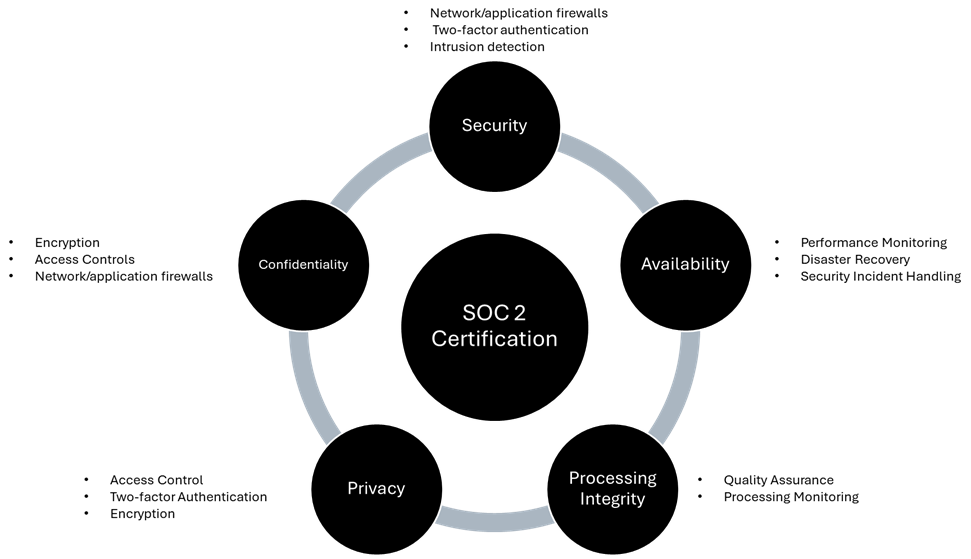
The Trust Services Criteria (TSC) are the AICPA’s control objectives against which a SOC 2 audit measures an organization’s security posture. Only Security is mandatory. The remaining four are selected based on the nature of the services provided and the commitments made to customers.
1. Security (Common Criteria) — Mandatory
Security protects systems and data from unauthorized logical and physical access. It is required for every SOC 2 audit and is the foundation all other criteria build on. The Security criterion maps to the AICPA’s Common Criteria (CC) series, which covers risk management, logical access, system operations, change management, and risk mitigation.
| Key control | Evidence artifact | Owner |
|---|---|---|
| Multi-Factor Authentication (MFA) enforced for all access to in-scope systems | IAM platform configuration screenshot; MFA enforcement report; exception register | IT / Security Engineering |
| Role-Based Access Control (RBAC) with least-privilege enforcement | Access control matrix; quarterly user access review records; provisioning and de-provisioning logs | IT / HR |
| Data encrypted at rest (AES-256) and in transit (TLS 1.2 or higher) | Encryption configuration documentation; certificate inventory; key management policy | Security Engineering |
| Vulnerability management: regular scanning and patching within defined SLA | Vulnerability scan reports; patch management records; critical finding SLA compliance evidence | Security Operations |
| Intrusion detection and SIEM monitoring with alerting | SIEM platform configuration; alert log samples; incident ticket evidence from triggered alerts | Security Operations |
| Penetration testing conducted annually or after major changes | Penetration test report; remediation tracking records; re-test evidence for critical findings | Security / Third-Party Vendor |
2. Availability
Availability ensures systems are operational and accessible as committed in service-level agreements (SLAs). This criterion is relevant for organizations with uptime commitments to customers. It encompasses infrastructure redundancy, incident response, disaster recovery, and capacity planning.
| Key control | Evidence artifact | Owner |
|---|---|---|
| Redundant infrastructure across availability zones or regions | Infrastructure architecture diagram; failover test records | Infrastructure / DevOps |
| Documented disaster recovery (DR) plan with defined RPO and RTO | DR plan document; DR test results with completion date | IT / Operations |
| System uptime monitoring with alerting below SLA threshold | Monitoring platform configuration; uptime reports for observation period; incident tickets for downtime events | Infrastructure / Security Operations |
| Capacity planning reviews conducted on schedule | Capacity review records with dates; capacity thresholds and action triggers documented | Infrastructure |
3. Processing Integrity
Processing Integrity ensures that system operations are complete, valid, accurate, timely, and authorized. It is most relevant for organizations that process financial transactions, healthcare data, or any business-critical data where errors have downstream consequences. This criterion covers input validation, error handling, audit trails, and change management.
| Key control | Evidence artifact | Owner |
|---|---|---|
| Input validation enforced at application layer | Code review records; input validation test results; error log samples showing rejected invalid input | Engineering |
| Audit trails capturing all data transactions and system changes | Audit log configuration; sample log exports showing transaction records with timestamps and user attribution | Engineering / Security |
| Change management process with approval, testing, and documentation requirements | Change management policy; change request tickets with approver records; production deployment logs | Engineering / Operations |
| Error handling procedures documented and tested | Error handling policy; error log samples; incident tickets for processing failures | Engineering |
4. Confidentiality
Confidentiality protects information designated as confidential from unauthorized disclosure throughout its lifecycle. This criterion covers data classification, access restrictions, encryption of confidential data, and contractual confidentiality obligations with employees and third parties.
| Key control | Evidence artifact | Owner |
|---|---|---|
| Data classification policy defining confidentiality tiers | Data classification policy document; data inventory with classification labels applied | Compliance / Legal |
| Access to confidential data restricted to authorized roles with documented justification | Access control matrix for confidential data stores; quarterly access review records | IT / Security |
| Confidential data encrypted at rest and in transit | Encryption configuration for all confidential data stores; key management records | Security Engineering |
| NDAs and confidentiality clauses in place with all employees and relevant third parties | Signed NDA records; third-party contract review confirming confidentiality clauses | Legal / HR |
5. Privacy
Privacy covers how personally identifiable information (PII) is collected, used, retained, disclosed, and disposed of in accordance with the organization’s privacy notice and applicable regulations including GDPR and CCPA.
| Key control | Evidence artifact | Owner |
|---|---|---|
| Privacy notice published and accurate | Published privacy notice with last-reviewed date; annual review record | Legal / Compliance |
| Data minimization: only data required for defined purposes is collected | Data inventory showing fields collected vs. stated purpose; engineering review confirming no excess data collection | Engineering / Compliance |
| Consent management: user consent documented for applicable data processing activities | Consent records; consent management platform configuration; audit trail of consent events | Engineering / Legal |
| Data retention and disposal schedule enforced | Data retention policy; deletion records or automated deletion logs; data disposal certificates for physical media | IT / Compliance |
| Data subject access request (DSAR) process documented and tested | DSAR procedure; records of DSAR requests handled within statutory timeframe | Legal / Compliance |
What Is the Difference Between SOC 2 Type 1 and Type 2?
The choice between Type 1 and Type 2 is the first practical decision in every SOC 2 program. Most enterprise customers and regulated industry buyers require Type 2, but organizations new to SOC 2 often begin with Type 1 to establish a baseline and start the observation clock for Type 2.
| Dimension | SOC 2 Type 1 | SOC 2 Type 2 |
|---|---|---|
| What it evaluates | Suitability of control design at a single point in time | Operating effectiveness of controls over a defined observation period |
| Observation period | None (point in time) | Minimum 6 months; typically 12 months for enterprise buyers |
| Evidence collected | Policies, configurations, and system designs as of the audit date | Policies, configurations, plus transactional evidence sampled across the full observation period |
| Auditor testing approach | Inspection and inquiry: are the controls in place? | Inspection, inquiry, and sampling: did the controls work consistently throughout the period? |
| Enterprise acceptance | Accepted by some customers as initial validation; most enterprise buyers require Type 2 | The gold standard; required by most enterprise procurement and vendor risk management programs |
| Typical timeline | 2 to 4 months from preparation to report | 9 to 18 months total from preparation through observation period to final report |
| Best for | Early-stage companies demonstrating initial security maturity; organizations starting the Type 2 observation period | Growth-stage and enterprise organizations seeking to satisfy procurement requirements and demonstrate sustained security program maturity |
What Happens During a SOC 2 Audit?
A SOC 2 audit is conducted by an independent CPA firm licensed by the AICPA. The audit process has three phases: preparation, fieldwork, and reporting. Understanding what auditors actually do at each phase helps organizations build evidence efficiently and avoid the most common causes of qualified findings.
- Scoping: The auditor and organization agree on which systems and services are in scope, which Trust Services Criteria apply, and what the observation period covers. Scope decisions have a direct impact on audit cost and complexity. Including only the systems that directly handle customer data, rather than the entire organization, is the most common and appropriate approach for early SOC 2 programs.
- Readiness assessment (pre-audit): Most experienced SOC 2 programs conduct a readiness assessment before the formal audit begins. This is either a self-assessment or a third-party advisory engagement that maps current controls to TSC requirements, identifies gaps, and produces a prioritized remediation plan. Findings discovered during readiness can be remediated before the formal audit starts. Findings discovered during the formal audit appear in the report as exceptions, visible to every customer the report is shared with.
- Fieldwork: The auditor collects evidence through documentation review, configuration inspection, and interviews with control owners. For Type 2, auditors use sampling: they select representative transactions, access events, change tickets, and log entries from across the observation period to test whether each control operated as designed. Common evidence types include user access review records, change management tickets, security training completion logs, vulnerability scan reports, and encryption configuration documentation.
- Reporting: The auditor issues a report containing the scope description, management’s assertion about control effectiveness, the auditor’s opinion, and a description of each tested control with any exceptions noted. Four opinion types are possible: Unqualified (controls operated effectively), Qualified (controls mostly effective but with identified exceptions), Adverse (controls were not effective), and Disclaimer of Opinion (insufficient evidence to form an opinion).
Which Organizations Need a SOC 2 Report?
SOC 2 is relevant for any organization that stores, processes, or transmits customer data on behalf of other organizations. The question is not whether to pursue SOC 2, but when. The answer is usually: before the first enterprise customer asks for it, because the sales cycle implications of not having a report are more disruptive than the compliance program itself.
| Organization type | Why SOC 2 is needed | Criteria most relevant | Typical trigger |
|---|---|---|---|
| SaaS providers | Enterprise buyers require SOC 2 as a condition of vendor onboarding. Without it, the sales cycle stalls at security review. | Security, Availability, Confidentiality | First enterprise customer security questionnaire or procurement requirement |
| Cloud infrastructure and IaaS providers | Customers rely on the provider’s SOC 2 report as part of their own compliance evidence chain. Missing or stale reports create gaps in customers’ audit packages. | Security, Availability | Enterprise customer contract requirement; FedRAMP adjacency |
| Managed Service Providers (MSPs) | MSPs have privileged access to customer environments. A security failure at the MSP directly affects every customer it serves. SOC 2 demonstrates the governance model governing that access. | Security, Confidentiality | Enterprise customer requirement; cyber insurance underwriting |
| Healthcare technology vendors and health tech companies | HIPAA requires covered entities to have BAAs with vendors handling PHI. Enterprise healthcare buyers increasingly require SOC 2 in addition to the BAA as evidence of technical safeguard effectiveness. | Security, Availability, Confidentiality, Privacy | Hospital or health system vendor onboarding requirement |
| Financial services and fintech companies | Financial institutions and their technology vendors face scrutiny from regulators who reference NIST and security frameworks. SOC 2 provides independent attestation of security controls that financial examiners increasingly expect. | Security, Processing Integrity, Confidentiality | Enterprise financial institution customer requirement; regulatory examination preparation |
| Data analytics and AI platform vendors | Organizations sharing sensitive data for analytics or AI training require assurance that the receiving organization protects data with independently audited controls. | Security, Confidentiality, Privacy | Data sharing agreement negotiation; enterprise prospect security review |
What Is the SOC 2 Compliance Roadmap?
SOC 2 compliance is a program, not a project. The nine-step roadmap below reflects the sequence that produces clean Type 2 reports with the least rework and the shortest elapsed time to enterprise-ready status.
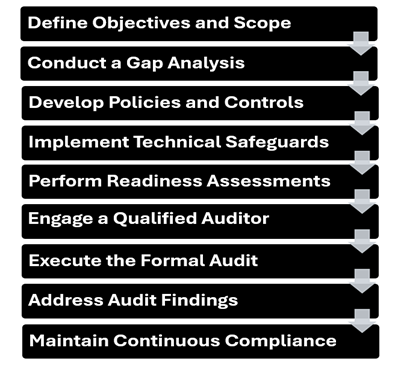
- Define scope and objectives: Identify which systems, services, and data flows handle customer data and fall within the audit boundary. Select which Trust Services Criteria apply based on service commitments. Decide whether to pursue Type 1 first or go directly to Type 2. Narrowing scope to systems that directly handle customer data is the most effective way to control audit complexity and cost without sacrificing coverage.
- Conduct a gap analysis: Map current controls to TSC requirements and identify what is missing, incomplete, or undocumented. This is where engaging a third-party advisory firm like Encryption Consulting produces the most value: an independent gap analysis surfaces findings that internal teams have normalized, and produces a remediation plan with prioritized actions, cost estimates, and realistic timelines before the audit clock starts.
- Develop policies and procedures: Document all security controls in formal policy format. Core required policies include: Information Security Policy, Access Control Policy, Incident Response Plan, Vendor Management Policy, Change Management Policy, Business Continuity and Disaster Recovery Plan, and Acceptable Use Policy. Policies must reflect actual operations, not aspirational practices. Auditors test whether controls operate as policies describe.
- Implement technical safeguards: Deploy the technical controls that policies require. Key implementations include: MFA enforcement across all in-scope systems, encryption at rest using AES-256 for all customer data stores including backups and dev environments, TLS 1.2 or higher for all data in transit, SIEM-based monitoring with defined alert thresholds, automated patch management with documented SLAs for critical vulnerabilities, and network segmentation separating production from development environments.
- Execute a readiness assessment: Conduct internal or third-party readiness testing before the formal audit begins. Test user access reviews by verifying all active accounts have current business justification. Test backup restore procedures. Simulate an incident response scenario. Review log completeness. A readiness assessment converts surprises in the formal audit into remediable gaps found internally.
- Engage a qualified CPA auditor: Select an independent CPA firm with SOC 2 experience relevant to your industry and technology stack. Compare proposals on scope, evidence requirements, sample sizes, and timeline. Provide the auditor with documentation packages: system description, policy library, control matrix, and preliminary evidence. Agree on the observation period start date for Type 2 engagements.
- Execute the formal audit: Support auditor fieldwork by making control owners available for interviews and providing evidence on request promptly. For Type 2, maintain evidence collection discipline throughout the full observation period. Every access review, change ticket, training completion record, and vulnerability scan report collected during the observation period is potential audit evidence.
- Remediate audit findings: Address exceptions identified in the audit report based on risk severity. Document each remediation action with the specific control gap addressed, the fix implemented, the date completed, and the person responsible. Communicate remediation progress to stakeholders who received the report and note planned completion dates for open items.
- Maintain continuous compliance: SOC 2 Type 2 is an annual renewal. Continuous compliance requires: automated evidence collection using compliance automation platforms, quarterly user access reviews, annual penetration testing, annual policy reviews and updates, ongoing security awareness training with documented completion, and incident response drills at least annually.
SOC 2 Audit-Ready Checklist
Use this checklist to assess your SOC 2 readiness before engaging a CPA auditor. Items are organized by Trust Services Criterion:
| Control area | Requirement | Evidence artifact | Owner | Status |
|---|---|---|---|---|
| Security: Access control | MFA enforced for all access to in-scope systems; RBAC with least-privilege enforced; quarterly user access reviews completed on schedule | MFA enforcement configuration; access control matrix; quarterly review records with completion dates | IT / Security | To action |
| Security: Encryption | Customer data encrypted at rest (AES-256 minimum) across all stores including backups and dev environments; TLS 1.2 or higher for all data in transit | Encryption configuration documentation; certificate inventory; key management policy and records | Security Engineering | To action |
| Security: Vulnerability management | Vulnerability scans run on schedule; critical findings remediated within defined SLA; annual penetration test completed | Scan reports with dates; patching records; pen test report and remediation tracking | Security Operations | To action |
| Security: Monitoring and SIEM | SIEM or equivalent monitoring operational with alert rules defined; security events logged and retained per policy | SIEM configuration; log retention policy; alert log samples from observation period | Security Operations | To action |
| Security: Incident response | Incident response plan documented, tested, and updated within last 12 months; tabletop exercise completed | IR plan with last-reviewed date; tabletop exercise records; actual incident tickets if applicable | Security / Legal | To action |
| Security: Vendor management | All third-party vendors with access to customer data assessed for security risk; contracts include security and confidentiality obligations | Vendor risk register; third-party security questionnaires or SOC 2 reports; contract review confirming security clauses | Procurement / Legal | To action |
| Security: Change management | All production changes go through defined approval and testing process; emergency changes documented post-hoc | Change management policy; change request tickets with approver records; production deployment logs | Engineering / Operations | To action |
| Availability: DR and redundancy | DR plan documented with defined RPO and RTO; DR test completed within last 12 months; infrastructure redundancy deployed | DR plan; DR test results with completion date; architecture diagram showing redundancy | Infrastructure / Operations | To action |
| Availability: Uptime monitoring | System uptime monitored with alerting below SLA threshold; capacity reviews conducted on schedule | Monitoring platform configuration; uptime reports for observation period; capacity review records | Infrastructure | To action |
| Processing Integrity: Audit trails | All data transactions and system changes captured in audit logs with timestamps and user attribution; logs retained per policy | Audit log configuration; sample log exports showing transaction records | Engineering / Security | To action |
| Confidentiality: Data classification | Data classification policy in place; confidential data stores identified and access restricted to authorized roles | Data classification policy; data inventory with classifications; access review for confidential data stores | Compliance / IT | To action |
| Privacy: Privacy notice and consent | Privacy notice published and accurate; consent management documented for applicable processing activities | Published privacy notice with last-reviewed date; consent management records | Legal / Compliance | To action |
| Privacy: Data retention and disposal | Retention schedule enforced; data disposal documented with certificates for physical media | Retention policy; deletion records or automated logs; disposal certificates | IT / Compliance | To action |
| All criteria: Policy library | Core policies documented, approved, and reviewed within last 12 months: Information Security, Access Control, Incident Response, Vendor Management, Change Management, BCP/DR, Acceptable Use | Policy library with approval signatures and last-reviewed dates | Compliance / Legal | To action |
| All criteria: Security awareness training | All employees completed annual security awareness training; training completion tracked and documented | Training completion records with employee names and completion dates | HR / Security | To action |
What Are the Most Common SOC 2 Compliance Challenges?
Three challenges consistently appear across SOC 2 programs regardless of organization size:
- Treating SOC 2 as a checkbox exercise: Organizations that optimize for getting the report rather than building effective controls produce clean reports and insecure environments. Auditors test a sample of controls; a sufficiently small sample will not catch every gap. The remedy is embedding security ownership in engineering and operations, not just compliance, and using SOC 2 scope as the baseline for the security program rather than the ceiling.
- Evidence collection gaps during the observation period: For Type 2, auditors sample evidence from across the full observation period. User access reviews completed for 10 of 12 months create a finding for the 2 months with no evidence. The remedy is automated evidence collection using compliance automation that continuously pulls access logs, configuration snapshots, and training records without requiring manual collection each time.
- Encryption gaps in non-primary data stores: Production databases are typically encrypted. Backups, development environments, data exports, and analytics copies of production data are frequently not. Auditors specifically test encryption coverage across all in-scope data stores, not just the primary production environment. The remedy is a cryptographic inventory that maps every data store to its encryption configuration before the audit begins, using tools like CBOM Secure to surface coverage gaps that manual inventories miss.
How Can Encryption Consulting Help With SOC 2 Compliance?
Encryption Consulting is an ISO/IEC 27001:2022 and SOC 2 certified applied-cryptography and compliance advisory firm. Our compliance advisory services cover the full SOC 2 lifecycle from gap analysis through audit support and continuous compliance.
- SOC 2 Gap Analysis and Readiness Assessment: We map your current security controls against all five Trust Services Criteria, identify gaps, and produce a prioritized remediation roadmap with cost estimates and realistic timelines. Gaps found during our readiness assessment are fixed before the audit starts; gaps found during the formal audit appear in the report as exceptions. The readiness investment consistently produces cleaner reports with fewer qualified findings.
- Cryptographic Control Assessment: Encryption is one of the most tested Security criterion controls, and encryption gaps in non-primary data stores are one of the most common audit findings. We conduct a complete cryptographic assessment of your in-scope environment using CBOM Secure, mapping every data store to its encryption configuration and identifying stores that are missing encryption coverage before the auditor tests for them. We also verify certificate lifecycle management controls covering TLS certificates used by in-scope systems.
- Key Management Governance: SOC 2 auditors verify that encryption key management follows documented procedures. We help organizations implement key management policies, HSM-based key storage for highest-sensitivity data using HSM-as-a-Service, and automated certificate lifecycle management that produces the renewal evidence auditors need to test certificate management controls.
- Policy Development and Evidence Package Preparation: We develop the core policy library that every SOC 2 audit requires, Information Security Policy, Access Control Policy, Incident Response Plan, Vendor Management Policy, Change Management Policy, and BCP/DR Plan, in formats that map directly to TSC requirements and produce the evidence artifacts auditors test against.
- Ongoing Compliance Support: For organizations maintaining annual SOC 2 Type 2 renewal cycles, we provide continuous advisory support covering policy annual reviews, cryptographic control monitoring, and preparation for each year’s audit evidence package.
Conclusion
SOC 2 compliance is the most operationally rigorous demonstration of security posture available to service organizations, precisely because it requires independent evidence of sustained control effectiveness rather than self-attestation. For SaaS providers, cloud vendors, MSPs, and healthcare technology firms, it is the audit report that enterprise customers require before sharing sensitive data. For organizations that approach it as a program rather than a project, it becomes a continuous improvement mechanism that strengthens security and opens enterprise markets simultaneously.
The organizations that achieve clean Type 2 reports with the shortest elapsed time are the ones that invest in a thorough gap analysis before the audit starts, build the evidence collection infrastructure during the observation period, and treat control ownership as a permanent function rather than an audit-season activity.
Frequently Asked Questions
What is SOC 2 compliance?
SOC 2 is the AICPA’s audit framework for evaluating how service organizations protect customer data across five Trust Services Criteria: Security (mandatory), Availability, Processing Integrity, Confidentiality, and Privacy. A licensed CPA firm conducts the audit and issues a report. Type 1 evaluates control design at a point in time; Type 2 evaluates operating effectiveness over 6 to 12 months. SOC 2 is voluntary but contractually required by most enterprise buyers before onboarding a SaaS provider, cloud vendor, or MSP.
What is the difference between SOC 2 Type 1 and Type 2?
SOC 2 Type 1 evaluates whether security controls are suitably designed at a single point in time: are the right controls in place today? SOC 2 Type 2 evaluates whether those controls operated effectively over a defined observation period of 6 to 12 months: did the controls work consistently over time? Enterprise customers almost universally require Type 2 because it demonstrates sustained security program maturity rather than a point-in-time design review.
How long does a SOC 2 audit take?
A SOC 2 Type 1 audit typically takes 2 to 4 months from preparation through report issuance. A SOC 2 Type 2 audit requires a 6 to 12 month observation period plus preparation and reporting time, making the total timeline 9 to 18 months from starting preparation to receiving the final report. Organizations that begin with Type 1 can use the observation period to accumulate Type 2 evidence, reducing total elapsed time.
Which Trust Services Criteria are mandatory?
Only Security (the Common Criteria series) is mandatory for every SOC 2 audit. Availability, Processing Integrity, Confidentiality, and Privacy are optional and selected based on the services provided and customer commitments. Organizations with uptime SLAs should include Availability. Organizations handling confidential business information should include Confidentiality. Organizations handling PII should include Privacy. Most enterprise buyers view all five criteria as a mark of mature governance.
What is the most common reason organizations fail a SOC 2 audit?
The most common audit findings are: user access reviews not performed on schedule, inconsistent evidence collection during the observation period, encryption not applied to all in-scope data stores including backups and dev environments, and gaps in vendor risk management documentation. Most of these findings are discoverable in a pre-audit readiness assessment and can be remediated before the formal audit begins.
Does SOC 2 satisfy HIPAA or GDPR requirements?
Not directly. SOC 2 provides strong evidence of security and privacy controls that overlaps with HIPAA technical safeguard requirements and GDPR data protection principles, but it does not replace the legal compliance obligations. HIPAA covered entities still need signed Business Associate Agreements with vendors. GDPR-subject organizations still need to conduct Data Protection Impact Assessments for high-risk processing. SOC 2 strengthens the evidence base for both but is not a legal substitute for either.
- Quick Answer: What Is SOC 2 Compliance?
- Key Takeaways
- What Is SOC 2 and How Does It Differ from Other Compliance Frameworks?
- What Are the Five SOC 2 Trust Services Criteria?
- What Is the Difference Between SOC 2 Type 1 and Type 2?
- What Happens During a SOC 2 Audit?
- Which Organizations Need a SOC 2 Report?
- What Is the SOC 2 Compliance Roadmap?
- SOC 2 Audit-Ready Checklist
- What Are the Most Common SOC 2 Compliance Challenges?
- How Can Encryption Consulting Help With SOC 2 Compliance?
- Conclusion
- Frequently Asked Questions