

- Key Takeaways
- Quick Checklist: Is Your Organization at Risk?
- Why Certificate Discovery Matters
- How Certificate Discovery Works
- Certificate Discovery and the Move to 47-Day TLS Certificates
- Owner and Action Matrix: Who Should Act
- Certificate Discovery Methods at a Glance
- How Can Encryption Consulting Help with Certificate Discovery
- Conclusion
- Frequently Asked Questions
Quick answer: Certificate discovery is the automated process of finding every digital certificate across an organization’s network, cloud, and endpoints, including ones issued by third-party Certificate Authorities. It gives security and PKI teams a real-time inventory of what exists, where it lives, and when it expires, which is the foundation for preventing outages, closing security gaps, and passing compliance audits.
Certificate discovery is your frontline defense against outages, security breaches, and compliance risks. By uncovering every digital certificate, including third-party certificates (like those issued by public Certificate Authorities (CAs) or external vendors), it ensures nothing slips through the cracks. This proactive process is not just about tracking what you manage internally, it is about mapping your entire certificate ecosystem to safeguard operations, secure communications, and maintain trust. Without visibility into what certificates exist, where they are deployed, and when they expire, organizations face serious risks like service outages, compliance failures, or security breaches. You can go through our education center article on certificate discovery for a detailed explanation.
In large-scale environments with thousands of certificates spread across teams and systems, a centralized certificate inventory is essential for maintaining control and visibility. It enables organizations to:
- Identify unknown or unmanaged certificates before they become a threat.
- Group and organize certificates by business unit, environment, or usage.
- Enforce access control and define lifecycle policies, such as renewal schedules, replacement intervals, and expiration alerts, so certificates are managed proactively and securely.
- Monitor certificate status and receive alerts for upcoming expirations.
- Map certificates to their devices, applications, or endpoints for accountability.
Key Takeaways
- Nearly half of enterprises (45%) reported certificate-related downtime in the past year, and 37.5% traced that downtime directly to expired certificates, according to DigiCert’s July 2025 Trust Pulse Survey.
- Public TLS certificate validity is shrinking on a fixed CA/Browser Forum schedule: 200 days by March 2026, 100 days by March 2027, and 47 days by March 2029, which makes manual tracking effectively unworkable.
- Certificate discovery combines network scanning, agent-based scanning, integration-based discovery, passive discovery, and directory scanning to build one accurate, continuously updated inventory.
- Effective ownership spans four teams: PKI, security, platform/infrastructure, and compliance, each with a distinct role in acting on discovery data.
- Automated, continuously updated discovery (rather than spreadsheets) is what actually prevents outages, reduces breach exposure, and produces audit-ready evidence.
Quick Checklist: Is Your Organization at Risk?
Answer these questions honestly. If you land on “no” more than once, certificate discovery should move up your priority list.
- Single source of truth: Do you have one inventory that covers every certificate, including ones issued by CAs outside your primary vendor?
- Expiration visibility: Can you list every certificate expiring in the next 30, 60, and 90 days without manually checking multiple systems?
- Ownership mapping: Is every certificate tied to a named owner or team, not just a server hostname?
- Cryptographic hygiene: Do you know which certificates still rely on deprecated algorithms like SHA-1 or undersized RSA keys?
- Cloud and DevOps coverage: Does your inventory include short-lived certificates issued inside Kubernetes clusters, secrets managers, and CI/CD pipelines?
- 47-day readiness: Could your current renewal process handle certificates that expire every 47 days instead of every 398 days?
Why Certificate Discovery Matters
Many organizations still rely on outdated methods to track their certificate landscape, often using spreadsheets to record the number of certificates or their expiration dates. Despite the availability of modern solutions, manual tracking remains common. This approach not only consumes time and resources but also introduces a high risk of human error, ultimately compromising the accuracy and reliability of the certificate inventory.
In contrast, real-time visibility tools offer automated discovery, continuous monitoring, and instant alerts for certificate changes or upcoming expirations. Unlike static spreadsheets, these tools provide a dynamic, always-updated view of the certificate environment, ensuring that security teams are immediately aware of expired, weak, or misconfigured certificates before they cause issues like application outages, compliance violations, or security breaches.
Some organizations already manage certificates in a semi-automated way and assume the problem is solved. It usually is not. Automation helps, but it does not close the whole gap on its own, especially as certificate volumes grow rapidly across cloud, DevOps, and IoT environments.
As organizations scale, it becomes nearly impossible to manually track every certificate in use, leading to serious risks such as service outages, non-compliance, and security vulnerabilities. Expired or misconfigured certificates can cause critical applications or websites to go down, resulting in financial loss and reputational damage. Worse, attackers can exploit unknown or weak certificates for Man-in-the-Middle (MitM) attacks or unauthorized access. Without a clear, real-time inventory of all certificates, who owns them, where they are deployed, and when they expire, organizations lack the visibility needed to protect their digital infrastructure.
This is where certificate discovery becomes essential. It solves this problem by continuously scanning and identifying all certificates, regardless of where they reside, so no asset goes unmanaged or unnoticed. It empowers security teams to detect and mitigate risks, enforce cryptographic policies, and automate renewals, which ultimately strengthens operational resilience and regulatory compliance.
Here are the specific factors that make certificate discovery important for enterprise organizations:
Visibility & Inventory
Studies show that the average enterprise manages over 10,000 digital certificates, spread across various environments, from public clouds and on-premise servers to containers and end-user devices. These certificates may come from different CAs, including public ones like DigiCert, Let’s Encrypt, and GlobalSign, and private CAs such as Microsoft CA or HashiCorp Vault, be provisioned using different tools, and serve various purposes.
When organizations rely on fragmented CA usage without centralized management, it becomes difficult to enforce consistent security policies. This fragmentation can lead to gaps in certificate renewal, inconsistent configurations, and increased risk of expired or weak certificates slipping through the cracks. According to DigiCert’s July 2025 Trust Pulse Survey, 56.6% of organizations said they were concerned about their ability to track certificate expiration dates, even though nearly 60% manage between 1,000 and 10,000 certificates and 80% expect that volume to keep growing over the next 12 months.
Without centralized visibility, managing these certificates becomes an impossible task. Certificate discovery provides a complete inventory of certificates, making it possible to monitor their status, usage, and compliance posture. It also supports hybrid and multi-cloud scenarios by continuously scanning across on-premise infrastructure, multiple public cloud providers, and containerized environments, giving organizations one real-time inventory that spans every deployment platform.
Preventing Costly Outages
A single expired certificate can bring down critical services: websites become inaccessible, APIs stop functioning, and customer trust takes a hit. In 2021, Microsoft Teams experienced a widespread outage caused by an expired TLS certificate, leaving millions of users unable to connect for hours. Expirations are usually caused not by negligence, but by a lack of visibility.
The scale of this problem is measurable. DigiCert’s July 2025 Trust Pulse Survey of enterprise security leaders found that 45% had experienced service downtime due to certificate-related incidents in the past year, and 37.5% attributed outages specifically to expired certificates, one of the most preventable causes of disruption in enterprise environments (DigiCert, July 2, 2025). Nearly a third of surveyed organizations reported losses between $50,000 and $250,000 tied to certificate incidents, and 18.5% reported losses above $250,000.
Discovery tools continuously monitor certificate validity and provide timely alerts, helping teams renew or replace certificates before they expire. They often integrate seamlessly with ticketing and alert platforms like ServiceNow and PagerDuty, enabling automated workflows that create renewal tickets or notify the right teams proactively. This ensures certificates are renewed or replaced well before expiration, preventing costly service disruptions.
Reducing Security Risk
Unmanaged certificates can be exploited by attackers. Self-signed, weak, or misconfigured certificates open doors to MitM attacks, impersonation, and unauthorized access. In the 2011 DigiNotar breach, attackers compromised a trusted certificate authority and used the fraudulent certificates it issued to intercept and spy on internet traffic, a case that still shapes how the industry thinks about CA trust today.
Regularly scanning for certificates that use deprecated or weak cryptographic algorithms, such as SHA-1 or RSA keys below recommended lengths, is also critical. These outdated algorithms weaken security and increase the risk of compromise over time. Certificate discovery helps identify risky or non-compliant certificates and cryptographic weaknesses, enabling security teams to take corrective action before attackers can exploit them.
Meeting Regulatory Compliance Requirements
Expired or misconfigured certificates can lead to encryption failures or untrusted connections, resulting in violations of data protection regulations. Compliance mandates like PCI DSS, HIPAA, GDPR, and others often require proper encryption and certificate management. For example, during PCI DSS audits, the presence of expired SSL/TLS certificates on payment systems can trigger compliance findings, potentially leading to fines and increased scrutiny. Discovery ensures that organizations can prove they are using valid, trusted certificates and are not exposing sensitive data to unnecessary risk.
Certificate discovery solutions also provide detailed audit trails and exportable compliance reports, enabling organizations to demonstrate continuous adherence to regulatory requirements. These features streamline the audit process by supplying auditors with clear, verifiable documentation of certificate status, usage, and lifecycle management.
Organizations can use our solution, CertSecure Manager, to manage their certificates, from discovery and inventory to issuance, deployment, renewal, revocation, and reporting.
How Certificate Discovery Works
Because certificates are spread across diverse systems, networks, and cloud environments, a multi-layered discovery approach is essential to ensure no certificate goes unnoticed. Effective certificate discovery combines several scanning methods and analysis techniques tailored to different IT assets to provide a comprehensive, real-time inventory. Here is how it typically works.
Network Scanning
Network scanning is the most common method for discovering certificates exposed over standard communication protocols. Discovery tools use techniques such as TCP port scanning, TLS/SSL handshakes, and banner grabbing to detect services running on common ports like 443 (HTTPS), 990 (FTPS), and 465/587 (SMTPS). When these services respond, the tool collects certificate metadata such as the subject name, issuer, expiration date, and cryptographic strength.
Popular open-source tools such as Nmap (with the ssl-cert and ssl-enum-ciphers scripts) and SSLyze are often used to perform deep TLS/SSL handshake analysis, detecting insecure ciphers, deprecated protocols, and certificate misconfigurations.
This approach is particularly effective for mapping certificates on both internet-facing and internal services, such as web servers, load balancers, and mail servers. It is not without challenges, though. Firewalls and network segmentation can block scanning attempts, especially in sensitive environments. Tools may also return false positives or miss certificates if services only respond under certain conditions. Overcoming these hurdles often requires coordination with IT and security teams, plus fine-tuning of the scan parameters.
Agent-Based Scanning
In environments where network scanning is restricted due to segmentation, firewalls, or policy constraints, agent-based scanning provides deeper visibility. Lightweight agents installed on servers, desktops, or other endpoints inspect local certificate repositories such as the Windows Certificate Store, Java keystores, and certificate files in formats like PEM, PKCS#12 (PFX/P12), and DER. On Linux, agents typically inspect file paths, application config directories, and system trust stores.
These agents can scan both system-level and application-specific stores, including certificates used by internal tools, web apps, or middleware. Once collected, the data is securely sent to a central console for analysis. This method is ideal for discovering certificates not exposed to the network, such as those used in code signing, email encryption, or authentication.
Integration-Based Discovery
Discovery tools can directly integrate with trusted certificate sources to fetch and reconcile certificate information. These integrations offer a real-time, authoritative source of certificate data, ensuring organizations stay informed about certificates issued across the environment.
Certificate Authority & Cloud Integration
Discovery tools can connect directly to public and private CAs, as well as cloud-native certificate management platforms, to fetch and reconcile certificate inventories. This integration provides a top-down view of certificate issuance, helping teams monitor expiry, ownership, and compliance across hybrid or multi-cloud environments. Supported integrations often include AWS Certificate Manager (ACM), Azure Key Vault, and Google Cloud Secret Manager.
DevOps & Secrets Management Integration
Modern DevOps workflows increasingly rely on automated certificate issuance. These integrations help identify short-lived, programmatically issued, or ephemeral certificates that may not appear in traditional inventories, giving full visibility into certificates embedded in containerized workloads, microservices, and automated deployments. Discovery tools integrate with Kubernetes clusters, secrets managers like HashiCorp Vault and CyberArk Conjur, and CI/CD pipelines such as GitHub Actions, Jenkins, and GitLab.
Passive Discovery
Passive discovery involves monitoring network traffic to detect TLS/SSL handshakes and extract certificate data without initiating connections or requiring endpoint access. Tools operating in this mode are usually deployed at network chokepoints, places where most traffic passes through, such as proxies, firewalls, or network taps. By analyzing handshake traffic, they can identify certificates used by devices or applications, whether managed or not. This is especially useful for discovering certificates on legacy systems, IoT devices, or unauthorized assets where no agents are installed and scanning is not possible. It also helps detect ephemeral or misused certificates in environments that change frequently.
Directory Scanning
Directory scanning significantly aids in auditing user and machine certificate usage by providing comprehensive visibility into how certificates are issued, deployed, and utilized across an organization. Many organizations distribute certificates through directory services like LDAP or Active Directory, or by using configuration management tools such as Ansible, Chef, or Puppet. Certificate discovery tools can scan these directories and configuration files to locate certificates embedded in user profiles, machine objects, or deployment scripts. This method is particularly useful for identifying certificates used in internal authentication mechanisms (smart cards, RADIUS, or 802.1x), SSO configurations, and application deployments.
Certificate Discovery and the Move to 47-Day TLS Certificates
Certificate discovery is about to become non-negotiable rather than a best practice. In April 2025, the CA/Browser Forum passed ballot SC-081v3, endorsed by Sectigo, to phase down the maximum validity of public TLS certificates on a fixed schedule: 200 days starting March 2026, 100 days starting March 2027, and 47 days starting March 2029 (Sectigo, April 14, 2025). That is a drop from today’s 398-day maximum to 47 days, meaning certificates that once renewed once a year will need to renew roughly eight times a year.
At that renewal frequency, an incomplete or outdated inventory stops being a minor inconvenience and starts causing outages every few weeks instead of once a year. Certificate discovery is the prerequisite for surviving this shift: you cannot automate renewal for certificates you do not know exist. Every certificate uncovered through network scanning, agent-based scanning, passive discovery, and directory scanning needs to feed into an automated renewal workflow before the 200-day cap takes effect.
The shift to 47-day TLS certificates is also a crypto agility forcing function. Shorter certificate lifecycles push organizations toward automation and away from manual issuance, which in turn makes it easier to rotate cryptographic algorithms as standards evolve, including the eventual move to post-quantum algorithms. Complete certificate discovery and a current cryptographic asset inventory, the kind our CBOM Secure solution builds, are the two building blocks of that agility. Our CBOM inventory-to-intelligence approach explains how a cryptographic bill of materials turns a raw certificate list into risk-ranked, actionable intelligence.
Organizations that are also planning their post-quantum cryptography migration should treat certificate discovery as step one. Our PQC readiness assessment starts from the same question certificate discovery answers: what cryptographic assets do you actually have, and where are they.
Owner and Action Matrix: Who Should Act
Certificate discovery only produces value if the right team acts on what it finds. Use this matrix to assign ownership before you roll out a discovery program.
| Team | Primary Responsibility | Action on Discovery Findings |
|---|---|---|
| PKI Team | Certificate issuance, CA relationships, and lifecycle policy | Reconcile discovered certificates against the CA inventory, retire rogue or self-signed certificates, and enforce issuance policy across all CAs in use |
| Security Team | Risk reduction and cryptographic hygiene | Flag weak algorithms (SHA-1, undersized RSA keys), investigate unmanaged certificates for MitM or impersonation risk, and prioritize remediation by exposure |
| Platform / Infrastructure Team | Application and service uptime | Map certificates to the applications, load balancers, and endpoints they protect, and wire expiration alerts into existing on-call and ticketing workflows |
| Compliance Team | Audit readiness and regulatory reporting | Pull discovery-generated audit trails for PCI DSS, HIPAA, and GDPR reviews, and confirm no expired or non-compliant certificate is protecting regulated data |
Certificate Discovery Methods at a Glance
No single scanning method covers every certificate in a modern environment. Use this table to decide which methods apply to your use case.
| Use Case | Recommended Method | Operational Owner | Expected Outcome |
|---|---|---|---|
| Internet-facing web servers and load balancers | Network scanning | Platform / Infrastructure Team | Complete map of public-facing certificates and their expiration dates |
| Certificates in local stores, keystores, or PKCS#12 files | Agent-based scanning | Security Team | Visibility into certificates not exposed over the network, including code signing and email encryption certificates |
| Multi-cloud and DevOps-issued certificates | Integration-based discovery | Platform / Infrastructure Team | Reconciled inventory across AWS ACM, Azure Key Vault, Kubernetes, and CI/CD pipelines |
| Legacy systems, IoT devices, and unmanaged assets | Passive discovery | Security Team | Detection of certificates on devices where agents cannot be installed |
| Directory-issued user and machine certificates | Directory scanning | PKI Team | Audit trail of certificates tied to smart cards, RADIUS, 802.1x, and SSO configurations |
How Can Encryption Consulting Help with Certificate Discovery
Encryption Consulting provides a specialized certificate lifecycle management solution, CertSecure Manager, which scans your entire network, identifies every certificate in use, and gives you a centralized inventory with key details like issuer, expiration, and ownership. By using CertSecure Manager, enterprises can proactively discover and monitor their certificate infrastructure, preventing unauthorized access and vulnerabilities.
With real-time alerts, ownership tagging, and integrations with your existing tools, we make it easy to prevent outages, enforce encryption policies, and stay compliant, including as the certificate validity schedule tightens toward 47 days. Whether it is rogue certificates or unknown assets, we help ensure no certificate goes unnoticed. CertSecure Manager provides:
- Real-time scanning of certificates across any of the CAs in your environment.
- The ability to renew, revoke, download, and manage certificates directly from the platform.
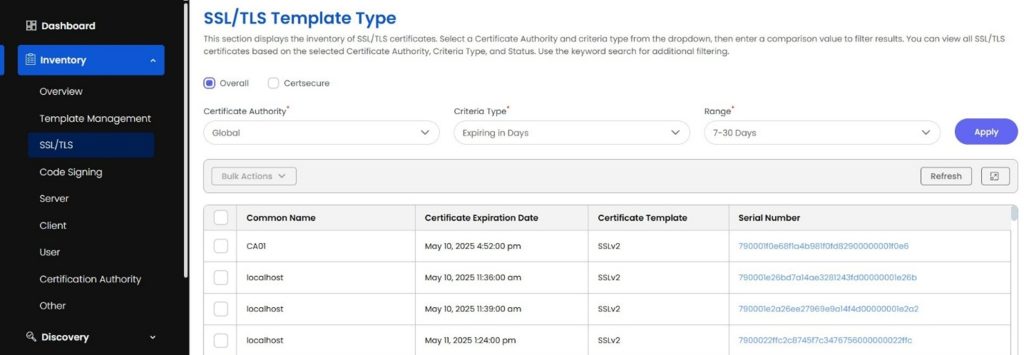
- A dashboard showing expiring, active, and total certificate counts for fast triage.
- Reporting and analysis built for both security teams and auditors.
- Multi-tenant environment support, including on-premises, cloud, SaaS, and hybrid deployments.
- Role-based access control (RBAC) and category-based filtering, so teams can segregate certificates without manual work. For example, a team can filter for every SSL/TLS certificate expiring in the next 7 to 30 days in a single view.
For teams looking further ahead, our CBOM Secure solution extends the same discovery approach beyond certificates to your full cryptographic estate, including algorithms, keys, and libraries, which is the inventory you will need for both crypto agility and post-quantum migration planning through our PQC Center of Excellence.
Improve security posture and compliance by identifying and removing unused or expired certificates, ensuring critical certificates are not missed or allowed to expire, and strengthening overall PKI infrastructure management.
Conclusion
Digital certificates are essential for securing modern infrastructure, but managing them without visibility is risky. As organizations adopt cloud, DevOps, and distributed systems, relying on manual tracking like spreadsheets leads to expired certificates, outages, and security gaps.
Certificate discovery solves this by providing real-time visibility into all certificates, regardless of where they are deployed. It helps identify risks, prevent downtime, and ensure compliance through centralized, automated management, and it becomes more important, not less, as public TLS certificates move toward a 47-day maximum lifespan.
In short, certificate discovery is not optional, it is a critical first step in protecting your digital environment. With the right solution and clear ownership across your PKI, security, platform, and compliance teams, organizations can eliminate blind spots, reduce operational risk, and maintain trust across every system.
Frequently Asked Questions
What is the main takeaway from Why Certificate Discovery Is Important for Organizations?
The main takeaway is that you cannot secure or automate what you cannot see. Certificate discovery builds a complete, continuously updated inventory of every certificate in your environment, which is the foundation for preventing outages, closing security gaps, and meeting compliance requirements like PCI DSS, HIPAA, and GDPR.
Why does this matter for enterprise certificate lifecycle management?
Certificate lifecycle management depends on knowing what needs to be renewed, revoked, or replaced, and discovery is how that list gets built. Without it, lifecycle management tools are only managing the certificates someone remembered to add, which is exactly how expired certificates cause outages.
What teams are responsible for acting on this guidance?
Four teams typically share responsibility: the PKI team handles issuance and CA reconciliation, the security team handles risk and cryptographic hygiene, the platform or infrastructure team maps certificates to applications and uptime, and the compliance team uses discovery data for audit evidence.
What risks increase if this topic is handled manually?
Manual tracking through spreadsheets increases the risk of missed renewals, undetected rogue or self-signed certificates, weak cryptographic algorithms going unnoticed, and compliance findings during audits. DigiCert’s July 2025 survey found 45% of organizations had certificate-related downtime in the past year, with 37.5% traced to expired certificates.
How does automation reduce certificate outage risk?
Automated discovery continuously scans for new and changed certificates and feeds expiration data into alerting and ticketing systems like ServiceNow or PagerDuty. This closes the gap between when a certificate is issued and when a human would otherwise notice it exists, which is what prevents surprise expirations.
What metrics should teams track after implementation?
Track total certificates discovered versus previously known, certificates expiring in the next 30/60/90 days, percentage of certificates with a named owner, count of certificates on deprecated algorithms, and mean time to renew after an expiration alert fires.
How does this connect to 47-day TLS certificate readiness?
The CA/Browser Forum’s approved schedule cuts public TLS certificate validity to 200 days by March 2026, 100 days by March 2027, and 47 days by March 2029. At that renewal frequency, an incomplete inventory causes renewal failures constantly rather than occasionally, so discovery has to be complete and automated before the shorter windows take effect.
How should this be handled in multi-cloud or hybrid PKI environments?
Multi-cloud and hybrid environments need integration-based discovery that connects directly to platforms like AWS Certificate Manager, Azure Key Vault, and Kubernetes secrets managers, combined with network and agent-based scanning for anything those integrations do not cover, so no environment becomes a blind spot.
- Key Takeaways
- Quick Checklist: Is Your Organization at Risk?
- Why Certificate Discovery Matters
- How Certificate Discovery Works
- Certificate Discovery and the Move to 47-Day TLS Certificates
- Owner and Action Matrix: Who Should Act
- Certificate Discovery Methods at a Glance
- How Can Encryption Consulting Help with Certificate Discovery
- Conclusion
- Frequently Asked Questions