
- Quick Answer: What Is TLS Encryption and Why Does It Matter?
- What Is TLS Encryption?
- The Evolution of TLS: From SSL to TLS 1.3
- How the TLS Handshake Works
- Cipher Suites: Algorithm Selection and Configuration
- Cipher Suite and Protocol Decision Table
- TLS Threat Model: What TLS Protects Against and What It Does Not
- TLS Key Management Dependencies
- The CA/B Forum 47-Day Certificate Validity Schedule
- Post-Quantum Cryptography (PQC) and the Future of TLS
- Performance and Interoperability Trade-offs
- TLS Deployment Examples
- TLS Limitations: What TLS Cannot Do
- How Encryption Consulting Can Help
- Conclusion
- Frequently Asked Questions
Transport Layer Security (TLS) is the cryptographic protocol that secures HTTPS, email, VPN traffic, and most authenticated communication on the internet. It provides three guarantees: confidentiality (data is encrypted so eavesdroppers cannot read it), authentication (the server’s identity is verified via a certificate from a trusted CA), and integrity (a message authentication code confirms data has not been tampered with in transit). The current standard is TLS 1.3 (RFC 8446, 2018). TLS 1.0 and 1.1 are deprecated. The CA/B Forum is reducing TLS certificate validity to 47 days by 2029, making automated certificate lifecycle management operationally mandatory.
Quick Answer: What Is TLS Encryption and Why Does It Matter?
TLS (Transport Layer Security) is the cryptographic protocol defined in RFC 8446 (TLS 1.3) that secures data in transit across networks. Without TLS, data travels in plaintext and is vulnerable to eavesdropping, man-in-the-middle attacks, and tampering. TLS provides confidentiality through symmetric encryption (AES-256-GCM), authentication through digital certificates verified against a trusted Certificate Authority (CA) hierarchy, and data integrity through AEAD (Authenticated Encryption with Associated Data). Over 90% of web pages loaded in Chrome use HTTPS, which runs on TLS. For enterprise security teams, TLS matters because misconfigured cipher suites, expired certificates, and deprecated protocol versions are exploitable vulnerabilities, and the CA/B Forum’s 47-day certificate validity mandate by March 2029 requires automation to manage at scale.
What Is TLS Encryption?
TLS is a cryptographic protocol designed to provide secure communication over a computer network. It operates at the transport layer (Layer 4) of the OSI model and secures data between a client (a browser, an email client, an API consumer) and a server. TLS integrates with Hardware Security Modules (HSMs) for private key protection and works alongside PKI infrastructure for certificate issuance and verification.
TLS ensures three core security properties:
- Confidentiality: data is encrypted so that only the intended recipient with the session key can read it. Eavesdroppers intercepting packets see only ciphertext.
- Authentication: the server presents a digital certificate signed by a trusted Certificate Authority (CA). The client verifies the certificate against the CA trust store to confirm it is talking to the legitimate server, not an impersonator.
- Integrity: AEAD (Authenticated Encryption with Associated Data) cipher modes ensure that any modification to ciphertext in transit is detected and the connection is terminated. Data that arrives but fails integrity verification is rejected.
TLS is the successor to Secure Sockets Layer (SSL), originally developed by Netscape in 1995. Though SSL and TLS are often used interchangeably in casual usage, they are distinct protocols. SSL is deprecated. TLS is the current standard. The current authoritative version is TLS 1.3, published by the IETF (Internet Engineering Task Force) as RFC 8446 in August 2018.
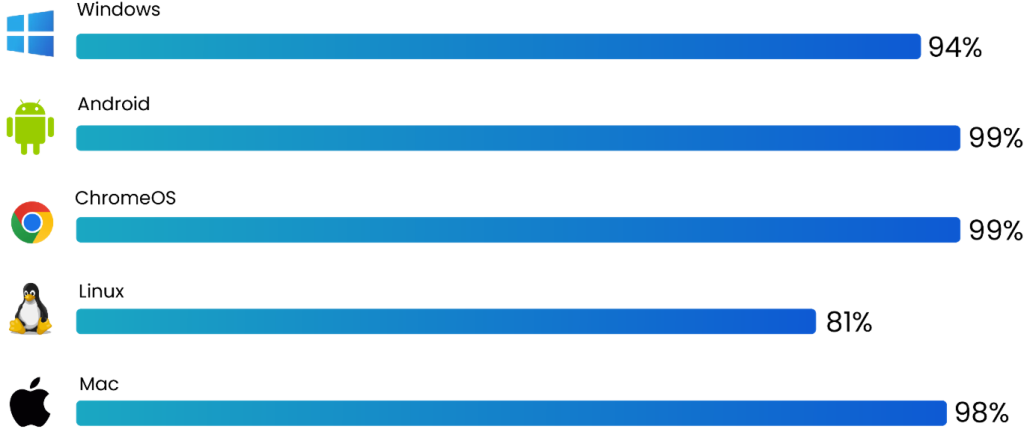
TLS is most visibly deployed in HTTPS (Hypertext Transfer Protocol Secure), the padlock icon in browsers. It also secures email (SMTP, IMAP, POP3 with STARTTLS or TLS), voice over IP (VoIP), virtual private networks (VPNs), and API communication across virtually every industry. According to Google’s Transparency Report, as of April 2025, over 90% of web pages loaded in Chrome use HTTPS, which relies on TLS.
The Evolution of TLS: From SSL to TLS 1.3
| Year | Version | Status | Key characteristics |
|---|---|---|---|
| 1994 | SSL 1.0 | Never released | Initial draft; security flaws prevented public release |
| 1995 | SSL 2.0 | Deprecated | First public release; multiple serious vulnerabilities including DROWN attack |
| 1996 | SSL 3.0 | Deprecated (RFC 7568, 2015) | Addressed SSL 2.0 weaknesses; vulnerable to POODLE attack; deprecated in 2015 |
| 1999 | TLS 1.0 (RFC 2246) | Deprecated (2020) | First TLS version; minor improvements over SSL 3.0; vulnerable to BEAST attack in CBC mode; deprecated by all major browsers in 2020 |
| 2006 | TLS 1.1 (RFC 4346) | Deprecated (2020) | Added protection against CBC padding attacks; deprecated alongside TLS 1.0 in 2020 |
| 2008 | TLS 1.2 (RFC 5246) | Current (acceptable) | Added AES-GCM and SHA-256 support; deprecated weak algorithms; widely deployed; acceptable when configured with strong cipher suites |
| 2018 | TLS 1.3 (RFC 8446) | Current (recommended) | 1-RTT handshake; mandatory perfect forward secrecy; removed RSA key exchange, CBC ciphers, SHA-1, MD5, DES, 3DES, RC4; 0-RTT session resumption; significantly reduced attack surface |
How the TLS Handshake Works
The TLS handshake establishes the secure session before any application data is transmitted. It authenticates the server, negotiates cryptographic parameters, and derives the session keys both parties will use. Here is the TLS 1.3 handshake sequence:
- ClientHello: the client sends the TLS version(s) it supports, a list of cipher suites in preference order, and key share values for the key exchange algorithms it supports (in TLS 1.3, the client sends key shares immediately rather than waiting for server selection, enabling 1-RTT). The client also sends a random nonce.
- ServerHello: the server selects the TLS version and cipher suite, responds with its own key share value for the selected key exchange algorithm, and sends a random nonce. At this point in TLS 1.3, both sides can compute the shared session key from the key shares using ECDHE or DHE without waiting for another round trip.
- Server Certificate and CertificateVerify: the server sends its digital certificate (containing its public key and identity information) and a signature proving it possesses the corresponding private key. The client verifies the certificate against its CA trust store and validates the signature.
- Server Finished: the server sends a Finished message encrypted with the session key, confirming the handshake parameters.
- Client Finished: the client sends its own Finished message. Both sides now have verified session keys and application data exchange begins.
TLS 1.2 requires two round trips (2-RTT) for a full handshake. TLS 1.3 requires one round trip (1-RTT). TLS 1.3 also supports 0-RTT session resumption for reconnecting clients, which allows application data to be sent in the first message. Note that 0-RTT data does not provide forward secrecy and is vulnerable to replay attacks; it should only be used for idempotent requests and must be carefully controlled.
Cipher Suites: Algorithm Selection and Configuration
A cipher suite is a named combination of algorithms that defines how TLS secures a connection. In TLS 1.2, a cipher suite specifies four components: the key exchange algorithm, the authentication algorithm, the encryption algorithm, and the MAC (message authentication code) algorithm. For example:
TLS_ECDHE_RSA_WITH_AES_256_GCM_SHA384 means: ECDHE key exchange, RSA authentication, AES-256-GCM encryption, SHA-384 integrity.
In TLS 1.3, cipher suites are simplified: key exchange and authentication are specified separately (both are mandatory ECDHE and mandatory signature verification), and the cipher suite only names the AEAD encryption algorithm and the hash function used for key derivation. TLS 1.3 supports exactly five cipher suites, all of which provide AEAD encryption and perfect forward secrecy:
- TLS_AES_256_GCM_SHA384 (recommended default)
- TLS_CHACHA20_POLY1305_SHA256 (recommended for mobile and constrained devices)
- TLS_AES_128_GCM_SHA256
- TLS_AES_128_CCM_SHA256
- TLS_AES_128_CCM_8_SHA256 (truncated tag; not recommended for general use)
Cipher Suite and Protocol Decision Table
| Scenario | Recommended configuration | What to disable | Why |
|---|---|---|---|
| New server deployment (all modern clients) | TLS 1.3 only; TLS_AES_256_GCM_SHA384 and TLS_CHACHA20_POLY1305_SHA256 | TLS 1.2 and below | Maximum security; eliminates all legacy attack surface |
| Mixed environment (must support older clients) | TLS 1.3 preferred; TLS 1.2 with ECDHE+AES-GCM only | RSA key exchange in TLS 1.2; CBC mode ciphers; SHA-1; MD5; DES; 3DES; RC4 | Maintains compatibility while eliminating exploitable configurations |
| Internal API or microservice communication | Mutual TLS (mTLS) with TLS 1.3; client and server both present certificates | Anonymous TLS; self-signed certificates without revocation | mTLS authenticates both sides; critical for zero-trust architectures |
| Legacy system that cannot support TLS 1.3 | TLS 1.2 with ECDHE key exchange and AES-256-GCM; disable all CBC suites | TLS 1.0; TLS 1.1; RC4; export ciphers; NULL encryption | TLS 1.0 and 1.1 are deprecated and vulnerable; even TLS 1.2 with weak suites is exploitable |
| High-assurance financial or healthcare deployment | TLS 1.3 only; HSM-backed private key storage; OCSP stapling; certificate pinning for known endpoints | All TLS 1.2 and below; software private key storage | Private key compromise enables MITM; HSM storage prevents key extraction |
| Email (SMTP, IMAP) | STARTTLS with TLS 1.2 minimum; DANE (DNS-Based Authentication of Named Entities) where supported | Opportunistic unencrypted fallback (if policy permits forcing TLS) | Email protocols use STARTTLS upgrade rather than direct TLS; DANE prevents certificate substitution attacks |
TLS Threat Model: What TLS Protects Against and What It Does Not
Understanding what TLS protects against and where its boundaries lie is essential for building a complete security posture:
| Threat | TLS protection | Notes |
|---|---|---|
| Passive eavesdropping (network interception) | Yes: encrypted with AES-256-GCM or CHACHA20-POLY1305 | Only protects data in transit; data at rest on server is not covered by TLS |
| Active man-in-the-middle (MITM) attack | Yes: server certificate authentication prevents impersonation | Depends on CA trustworthiness and correct certificate validation; certificate pinning adds additional defense |
| Data tampering in transit | Yes: AEAD detects and rejects tampered ciphertext | Any bit flip in ciphertext produces authentication tag failure and connection termination |
| Replay attacks | Partial: session nonces prevent standard replay; 0-RTT data in TLS 1.3 is vulnerable to replay | Applications must implement anti-replay for sensitive 0-RTT data |
| Private key compromise (future decryption) | Yes (TLS 1.3): perfect forward secrecy means past sessions cannot be decrypted with a stolen server key | TLS 1.2 with RSA key exchange lacks PFS; a stolen key can decrypt previously recorded sessions |
| Endpoint compromise (malware on client or server) | No: TLS secures the channel, not the endpoints | If the server or client is compromised, the attacker reads plaintext after TLS decryption |
| CA compromise or misissuance | Partial: Certificate Transparency (CT) logs detect misissuance; CAA records restrict which CAs can issue for a domain | CA/B Forum requirements, CT enforcement, and CAA records reduce but do not eliminate CA risk |
| Quantum computing attack on session keys | No (current TLS): RSA and ECC are vulnerable to Shor’s algorithm | Hybrid PQC key exchange (ECDHE + ML-KEM) is in IETF standardization; organizations should begin PQC readiness planning |
TLS Key Management Dependencies
TLS security rests on the integrity of the server’s private key. If the private key is compromised, an attacker can impersonate the server, perform man-in-the-middle attacks against future connections, and (in TLS 1.2 without PFS) decrypt previously recorded sessions.
Key management requirements for TLS deployments:
- Hardware Security Module (HSM) storage for high-assurance environments: storing private keys in a FIPS 140-3 validated HSM prevents key extraction even if the server operating system is compromised. The private key operation (signing the key exchange during the TLS handshake) occurs inside the HSM; the key material never enters server memory. This is required for high-assurance financial, healthcare, and federal deployments.
- Private key per service, not shared keys: sharing a private key across multiple servers or services means a compromise at any one point exposes all of them. Each service should have its own key pair and certificate.
- Key rotation tied to certificate renewal: when a certificate is renewed, the private key should also be rotated rather than reusing the existing key. This limits the exposure window if a key is compromised without being detected.
- Immediate revocation on suspected compromise: if a private key may have been exposed, the corresponding certificate must be revoked immediately through the issuing CA. Certificate revocation via CRL (Certificate Revocation List) or OCSP (Online Certificate Status Protocol) communicates the revocation to relying parties. OCSP stapling improves revocation check performance and privacy.
The CA/B Forum 47-Day Certificate Validity Schedule
On April 11, 2025, the CA/Browser Forum approved Ballot SC-081v3, requiring a phased reduction in the maximum validity period of TLS certificates from 398 days to 47 days by March 15, 2029. The phased schedule:
- March 15, 2026: maximum TLS certificate validity reduced to 200 days
- March 15, 2027: maximum TLS certificate validity reduced to 100 days
- March 15, 2029: maximum TLS certificate validity reduced to 47 days
Shorter certificate validity periods improve security by reducing the window during which a compromised certificate remains valid. They also reduce the impact of delayed revocation: if a certificate is compromised but not immediately revoked, shorter lifetimes limit the exposure period.
The operational implication is direct: organizations that manually track and renew certificates cannot operate reliably at 47-day validity periods. At that cadence, each certificate must be renewed approximately every six weeks, which requires automated certificate lifecycle management using ACME (Automatic Certificate Management Environment) protocol. ACME-based automation eliminates manual renewal and the associated expiry risk.
Post-Quantum Cryptography (PQC) and the Future of TLS
The asymmetric algorithms used for TLS key exchange and certificate authentication, RSA and elliptic curve cryptography (ECC), are vulnerable to Shor’s algorithm running on a cryptographically relevant quantum computer (CRQC). A CRQC can break RSA-2048 and P-256 ECDHE. TLS sessions protected by these algorithms can be decrypted retroactively if an adversary has recorded the traffic, which is the Harvest Now, Decrypt Later (HNDL) threat.
NIST finalized three post-quantum standards in August 2024:
- FIPS 203 (ML-KEM, formerly CRYSTALS-Kyber): key encapsulation mechanism for key exchange, replacing ECDHE in TLS key exchange
- FIPS 204 (ML-DSA, formerly CRYSTALS-Dilithium): digital signature algorithm for certificate authentication, replacing RSA and ECDSA in TLS certificates
- FIPS 205 (SLH-DSA, formerly SPHINCS+): hash-based signature algorithm as an alternative for certificate signing
For TLS, the transition has two components. First, key exchange: hybrid key exchange combining ECDHE with ML-KEM (X25519MLKEM768 is the leading candidate in browser deployments) provides quantum-resistant session confidentiality while maintaining backward compatibility during the transition. The IETF draft-ietf-tls-hybrid-design specifies the mechanism for TLS 1.3. Second, server certificates: replacing RSA or ECDSA server certificates with ML-DSA certificates addresses the server authentication component. ML-DSA public keys are larger than ECC keys, which increases handshake size and certificate chain size, but the performance impact is manageable for most deployments.
NIST IR 8547 (Initial Public Draft, November 2024) proposes deprecating RSA, ECDSA, ECDH, and finite-field Diffie-Hellman after 2030 and disallowing them after 2035. Organizations should begin PQC readiness planning now, particularly for TLS deployments protecting long-lived sensitive data where HNDL exposure is a real risk. Our PQC Advisory Services provide a nine-phase roadmap for this migration.
Performance and Interoperability Trade-offs
- TLS 1.3 vs TLS 1.2 latency: TLS 1.3’s 1-RTT handshake reduces connection setup latency compared to TLS 1.2’s 2-RTT. For high-frequency short-lived connections, this is a meaningful performance improvement. Session resumption in TLS 1.3 (via pre-shared keys) further reduces latency for reconnecting clients.
- AES-GCM vs ChaCha20-Poly1305: AES-GCM is faster on hardware with AES-NI acceleration (most modern server processors). ChaCha20-Poly1305 is faster on devices without hardware AES acceleration (older mobile devices, IoT). Offering both and letting the client select based on its capabilities is the standard approach.
- ECDHE key size: X25519 (Curve25519) and P-256 are the most commonly used ECDHE curves. X25519 is faster and has a simpler implementation with no known timing attack surface; P-256 is required in environments with FIPS compliance requirements. Both provide 128-bit security for key exchange.
- PQC overhead: ML-KEM public keys (approximately 1,184 bytes for ML-KEM-768) are larger than ECC keys (32 bytes for X25519), increasing handshake size. Hybrid key exchange adds both keys, roughly doubling the key exchange overhead. This is manageable for most deployments but requires attention for constrained networks or very high connection rates.
- HSM performance: using an HSM for private key operations adds latency per TLS handshake because the signing operation occurs in the HSM rather than in server memory. For high-throughput TLS termination, HSM performance must be factored into capacity planning.
TLS Deployment Examples
HTTPS web server (nginx, TLS 1.3 preferred): the recommended nginx TLS configuration for a production web server in 2026 sets ssl_protocols TLSv1.3 TLSv1.2, ssl_ciphers to exclude all non-PFS and CBC suites, enables OCSP stapling, configures HSTS (HTTP Strict Transport Security) with a long max-age, and stores the private key path pointing to the HSM PKCS#11 interface rather than a software file for high-assurance deployments.
Mutual TLS (mTLS) for internal API authentication: in a zero-trust architecture, internal services authenticate each other using mTLS. Both the client service and the server service present certificates. The server verifies the client certificate against the internal CA trust store before processing the request. This eliminates API key or token-based authentication for service-to-service communication, replacing it with certificate identity that can be centrally revoked. CertSecure Manager manages the certificate lifecycle for mTLS deployments including automated renewal before expiry.
Email security with STARTTLS and DANE: email servers use STARTTLS to upgrade an unencrypted SMTP connection to TLS. DANE (DNS-Based Authentication of Named Entities, RFC 7671) uses DNSSEC-signed TLSA records to specify exactly which certificate or CA is valid for a given mail server, preventing certificate substitution attacks where an attacker presents a certificate from a different CA for the same domain.
TLS Limitations: What TLS Cannot Do
- TLS secures the channel, not the endpoints: if the client or server is compromised by malware, the attacker reads plaintext after TLS decryption. Endpoint security is a separate and necessary layer.
- TLS does not protect data at rest: encrypted in transit does not mean encrypted at rest. Data stored on servers after TLS delivery requires separate encryption controls.
- CA trust is a dependency: TLS authentication depends on the trustworthiness of the CA hierarchy. A CA that issues a fraudulent certificate for a domain can enable MITM attacks. Certificate Transparency (CT) logging, CAA (Certification Authority Authorization) DNS records, and certificate pinning are mitigations.
- TLS 1.2 without PFS has historical decryption risk: traffic recorded today that was encrypted with TLS 1.2 using RSA key exchange (no PFS) can be decrypted if the server’s private key is later obtained, whether by breach, legal order, or quantum computer. This is the HNDL (Harvest Now, Decrypt Later) threat for historical data.
How Encryption Consulting Can Help
- CertSecure Manager: CertSecure Manager is Encryption Consulting’s certificate lifecycle management platform. It automates TLS certificate discovery, issuance, renewal, and revocation across on-premises, cloud, and hybrid environments, with ACME protocol support for automated renewal at 47-day validity schedules. CertSecure Manager provides centralized visibility across all certificates, compliance reporting for PCI-DSS, GDPR, and CA/B Forum requirements, and integration with major CAs and HSMs.
- ACME Enterprise Automation: CertSecure ACME provides enterprise-grade ACME protocol automation, enabling organizations to manage certificate renewal at the frequency the CA/B Forum’s 47-day schedule requires without manual intervention.
- PKI as a Service: PKI as a Service provides a managed certificate authority for organizations that need the PKI infrastructure to issue and manage TLS, mTLS, and code signing certificates without operating on-premises CA hardware.
- HSM as a Service: HSM as a Service provides FIPS 140-3 validated hardware private key storage for TLS deployments requiring hardware-backed key protection.
- PQC Advisory Services: our PQC Advisory Services help organizations plan and execute the migration from RSA and ECDSA TLS configurations to ML-KEM and ML-DSA, including hybrid key exchange deployment for the transition period.
- Encryption Advisory Services: our Encryption Advisory Services assess current TLS configurations across your environment, identify deprecated protocols and weak cipher suites, and recommend remediation aligned to current NIST guidance and CA/B Forum requirements.
Conclusion
TLS is the foundational security protocol for internet communication, and understanding it correctly is essential for enterprise security architects, developers, and compliance teams. The current standard is TLS 1.3: 1-RTT handshake, mandatory perfect forward secrecy, AEAD-only cipher suites, and a dramatically reduced attack surface compared to TLS 1.2. TLS 1.0 and 1.1 are deprecated and must not be used.
Two operational challenges dominate enterprise TLS management in 2026. First, the CA/B Forum’s 47-day certificate validity mandate by March 2029 makes automated certificate lifecycle management operationally mandatory, not optional. Second, the post-quantum transition requires planning to replace RSA and ECDSA-based TLS with ML-KEM key exchange and ML-DSA certificates before NIST’s 2030 deprecation and 2035 disallowance dates arrive.
TLS properly deployed, with strong cipher suites, hardware-backed private keys, automated certificate lifecycle management, and a PQC migration roadmap, is the foundation that everything else in network security builds on. If you need to assess your current TLS posture, automate certificate management, or plan your PQC migration, contact Encryption Consulting to discuss how we can help.
Frequently Asked Questions
What is TLS encryption?
TLS (Transport Layer Security) is the cryptographic protocol (current standard: RFC 8446, TLS 1.3, 2018) that secures data in transit by providing confidentiality (AES-256-GCM encryption), server authentication (digital certificate from a trusted CA), and data integrity (AEAD authentication tag). TLS 1.0 and 1.1 are deprecated. TLS 1.2 is acceptable with strong configuration. TLS 1.3 is the recommended standard.
What is the difference between TLS 1.2 and TLS 1.3?
TLS 1.3 reduces the handshake from 2-RTT to 1-RTT, makes perfect forward secrecy mandatory (all key exchange is ephemeral ECDHE or DHE), and removes support for RSA key exchange, CBC mode ciphers, SHA-1, MD5, DES, 3DES, and RC4. TLS 1.2 remains acceptable when configured with ECDHE key exchange and AES-GCM or ChaCha20-Poly1305; the risk comes from weak TLS 1.2 configurations that enable legacy algorithms.
What cipher suites should I use for TLS?
For TLS 1.3: TLS_AES_256_GCM_SHA384 and TLS_CHACHA20_POLY1305_SHA256 as preferred defaults. For TLS 1.2: ECDHE-based suites with AES-GCM only. Disable: RSA key exchange (no PFS), all CBC mode ciphers, SHA-1, MD5, DES, 3DES, RC4, and export-grade algorithms.
What is the CA/B Forum 47-day certificate validity schedule?
CA/B Forum Ballot SC-081v3 (April 11, 2025) requires: 200-day maximum by March 15, 2026; 100-day maximum by March 15, 2027; 47-day maximum by March 15, 2029. Manual certificate management cannot scale to 47-day validity; ACME-based automation with a platform like CertSecure Manager is operationally required.
How does post-quantum cryptography affect TLS?
RSA and ECC (used for TLS key exchange and certificates) are vulnerable to Shor’s algorithm on a quantum computer. NIST finalized ML-KEM (FIPS 203), ML-DSA (FIPS 204), and SLH-DSA (FIPS 205) in August 2024. For TLS, hybrid key exchange (ECDHE + ML-KEM) protects session confidentiality during the transition; ML-DSA certificates replace RSA/ECDSA for server authentication. NIST IR 8547 proposes deprecating classical algorithms after 2030 and disallowing them after 2035.
What key management does TLS depend on?
TLS security depends on protecting the server private key. Store private keys in a FIPS 140-3 HSM for high-assurance deployments. Use separate key pairs per service. Rotate keys at certificate renewal. Revoke immediately on suspected compromise using OCSP or CRL. OCSP stapling improves revocation check performance and privacy.
- Quick Answer: What Is TLS Encryption and Why Does It Matter?
- What Is TLS Encryption?
- The Evolution of TLS: From SSL to TLS 1.3
- How the TLS Handshake Works
- Cipher Suites: Algorithm Selection and Configuration
- Cipher Suite and Protocol Decision Table
- TLS Threat Model: What TLS Protects Against and What It Does Not
- TLS Key Management Dependencies
- The CA/B Forum 47-Day Certificate Validity Schedule
- Post-Quantum Cryptography (PQC) and the Future of TLS
- Performance and Interoperability Trade-offs
- TLS Deployment Examples
- TLS Limitations: What TLS Cannot Do
- How Encryption Consulting Can Help
- Conclusion
- Frequently Asked Questions