
- What Do EV, OV, and DV Certificates Actually Validate?
- Do Browsers Still Show Special EV UI in 2026?
- DV vs. OV vs. EV: How Do They Compare?
- What Are the Pros of EV SSL Certificates?
- What Are the Cons of EV SSL Certificates?
- How Do You Get an EV SSL Certificate?
- What Are the Performance and Interoperability Trade-offs of EV Certificates?
- What Key-Management Dependencies Come With EV Certificates?
- Where Does EV Still Make Sense in 2026?
- Limitations
- What Would Encryption Consulting Recommend?
- Frequently Asked Questions
- Conclusion
A green address bar used to mean something. It doesn’t anymore, and that single fact should drive most of what you decide about Extended Validation (EV) SSL certificates in 2026.
Quick answer: An EV SSL certificate proves a Certificate Authority (CA) verified a website operator’s legal existence, physical location, and operational authority, not just control of the domain. Chrome, Firefox, Safari, and Edge all removed the special green address bar and organization-name display back in 2019, so EV no longer changes what a visitor sees. Choose OV or well-automated DV for most sites; reserve EV for the specific regulatory, contractual, or code-signing cases where an EV mandate is real and named.
Key takeaways:
- EV validates the legal identity of the organization behind a domain. DV validates only domain control, and OV adds basic organization verification without EV’s full legal and physical checks.
- No major browser has shown EV’s green bar or organization name in the address bar since 2019. Chrome moved it to Page Info starting in Chrome 77; Firefox and Safari made equivalent changes the same year.
- EV issuance takes days to weeks and costs several times more than DV or OV, which sits badly against the CA/Browser Forum’s shrinking validity schedule: 200 days from March 2026, 100 days from March 2027, and 47 days from March 2029.
- EV SSL and EV Code Signing are different products governed by different CA/B Forum guidelines. EV Code Signing still requires a hardware-protected private key and remains relevant for driver and kernel-mode software.
- Most organizations get equivalent practical trust from OV certificates managed through automated lifecycle tooling, at a fraction of EV’s cost and re-validation overhead.
Published: September 2023. Updated: August 2026. Reviewed by Encryption Consulting’s PKI Services team.
What Do EV, OV, and DV Certificates Actually Validate?
EV, OV, and DV certificates all encrypt traffic identically; they differ only in how much a CA verifies about the entity behind the domain before issuing the certificate. Extended Validation (EV) requires a Certificate Authority to confirm a business’s legal existence, physical operating address, and authorization to request the certificate. Organization Validation (OV) confirms the organization is real and controls the domain, checked against business registries, but skips EV’s deeper physical and legal review. Domain Validation (DV) confirms only that the requester controls the domain, typically through DNS, email, or an HTTP token, with no organizational check at all.
The rules for EV specifically come from the CA/Browser Forum’s Guidelines for Extended Validation Certificates, currently version 2.0.4 (effective August 13, 2026, adopted via ballot SC102). The CA/B Forum is the industry body of Certificate Authorities and browser vendors (Chrome, Firefox, Safari, Edge among them) that writes the Baseline Requirements and EV Guidelines every publicly trusted CA must follow. Under those guidelines, EV issuance includes verifying the applicant’s legal existence and identity through qualified government sources, confirming a verified physical and operational address, calling a verified phone number for the organization, and confirming the individual requesting the certificate is authorized to do so on the organization’s behalf. Every publicly trusted certificate, EV included, must also be logged to a public Certificate Transparency (CT) log before browsers will trust it, which is a separate, browser-enforced auditability requirement, not an EV-specific one.
If you are choosing between validation levels for the first time, our guide to buying a certificate from a Certificate Authority walks through the DV, OV, and EV decision in more depth, and our overview of public versus private Certificate Authorities covers who is allowed to issue any of these in the first place.
Do Browsers Still Show Special EV UI in 2026?
No. As of 2026, none of the four major browsers give an EV certificate any distinct on-page visual treatment. Chrome removed the EV badge and organization name from the address bar starting with Chrome 77 in September 2019, moving that information into the Page Info panel behind the lock icon, after Chrome’s security UX team found the address-bar badge did little to help users spot fraud. Firefox made the equivalent change in Firefox 70 the same year, and Safari discontinued its own organization-name display around the same period. Edge, rebuilt on Chromium since 2020, has never restored a distinct EV indicator. In every one of these browsers today, an EV certificate’s organization details sit one click away in the same certificate-details view that DV and OV certificates use, with no visual difference in the address bar itself.
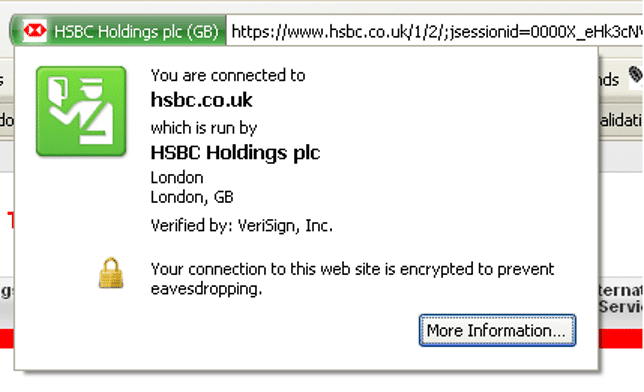
This means the single feature that made EV worth buying for most website owners, a visible trust signal every visitor could see without clicking anything, has been gone for more than five years. Any vendor or article still describing a “green address bar” as a current EV benefit is describing a browser behavior that no longer exists.
DV vs. OV vs. EV: How Do They Compare?
| Criteria | DV Certificate | OV Certificate | EV Certificate |
|---|---|---|---|
| What is validated | Domain control only | Domain control plus organization existence | Domain control, legal existence, physical and operational address, and issuance authorization |
| Issuance time | Minutes, fully automatable via ACME | Hours to a few days | Several days to a few weeks |
| Relative cost | Lowest, often free (e.g. Let’s Encrypt) | Moderate | Highest, typically several times an OV certificate |
| Browser UI treatment | Standard padlock, no distinct indicator | Standard padlock, no distinct indicator | Standard padlock; no distinct indicator since 2019 |
| Best-fit use case | Blogs, internal tools, high-volume automated fleets, dev/test environments | Most business and e-commerce sites wanting a verifiable organizational identity | Sites with a specific contractual, regulatory, or B2B relying-party requirement naming EV |
What Are the Pros of EV SSL Certificates?
EV’s remaining benefits are real but narrower than they were a decade ago, and they no longer include a visible browser indicator.
Genuine legal-entity vetting. An EV certificate is the only publicly trusted certificate type where a CA has confirmed the requesting organization’s legal existence, physical address, and authorization under a documented, auditable process defined by the CA/B Forum EV Guidelines.
Machine-readable identity data. The organization fields inside an EV certificate can be checked programmatically by relying parties, such as a partner API or B2B integration that validates the certificate’s subject fields itself rather than depending on a browser UI.
Contractual and audit alignment. Some processor agreements, government procurement rules, and internal security policies still name EV explicitly, and holding one satisfies that requirement without a policy exception.
A harder target for casual impersonation. Because EV issuance requires verified legal documentation, it is harder (though not impossible) for an attacker to obtain an EV certificate in a specific target company’s exact legal name, compared to a DV certificate on a look-alike domain.
What Are the Cons of EV SSL Certificates?
No consumer-visible advantage. Since 2019, EV produces the exact same address bar as DV and OV in every major browser, so it no longer influences visitor behavior the way it did before.
Cost. EV certificates typically cost several times more than an equivalent OV certificate, for a benefit that is now mostly internal or contractual rather than visitor-facing.
Slow issuance that collides with shorter validity. Manual legal and phone verification takes days to weeks, which is a poor fit as maximum certificate validity drops toward 47 days under the CA/B Forum’s SC-081v3 schedule.
Heavier renewal overhead. Unlike DV, EV’s organizational vetting cannot be fully automated the way ACME automates domain validation, so each renewal cycle still needs some human document review.
No wildcard EV certificates. The CA/B Forum EV Guidelines prohibit wildcard SANs on EV certificates, so multi-subdomain deployments need a multi-domain EV certificate or per-subdomain issuance instead.
Stolen and mis-issued EV certificates still circulate. EV vetting reduces but does not eliminate the risk of a fraudulently obtained certificate reaching the dark web, so EV should never be an organization’s only anti-phishing control.
How Do You Get an EV SSL Certificate?
EV issuance follows a fixed sequence defined by the CA/B Forum EV Guidelines. Expect it to take longer than any DV or OV order you have placed before.
Choose a CA that issues EV. Confirm the CA is publicly trusted and offers EV under the current CA/B Forum guidelines, and compare turnaround times, since EV vetting speed varies more between CAs than DV or OV does.
Assemble legal and operational documentation. Gather articles of incorporation or equivalent registration records, proof of physical operating address, and identification for the authorized requester.
Generate a Certificate Signing Request (CSR). Create a key pair and CSR for the domain, keeping the private key secured on the server or, ideally, inside an HSM rather than as a flat file.
Submit the CSR and documentation to the CA. The CA opens a vetting case and begins independently verifying every claim rather than trusting the submitted paperwork alone.
Complete legal, physical, and phone verification. Expect a verification call to a phone number the CA sources independently, not one you supply, plus cross-checks against government and business registries.
Confirm domain control and issuance authorization. Alongside the organizational checks, the CA still confirms domain control and that the named requester is authorized to obtain a certificate for that organization.
Receive, install, and test the certificate. Install the issued certificate on your server or load balancer and verify the full chain builds correctly in each browser and client you support.
Schedule renewal well ahead of expiry. Because re-verification is not instant, start EV renewal weeks, not days, before the current certificate’s validity ends.
What Are the Performance and Interoperability Trade-offs of EV Certificates?
EV adds no TLS handshake performance penalty. Validation level is a certificate-profile and policy-OID distinction checked once, not a different cipher suite or key exchange, so an EV certificate negotiates TLS 1.2 or TLS 1.3 exactly as fast as a DV or OV certificate on the same key type and size. Every current browser and TLS-capable client supports EV certificates identically to other validation levels; there is no EV-specific compatibility gap on modern clients.
The real trade-off is operational, not technical. DV and increasingly OV issuance can run through ACME with little to no human involvement, which is what makes the industry’s move toward much shorter certificate lifetimes workable. EV’s legal and physical vetting resists that level of automation because a human still has to review documentation and place a verification call on each vetting cycle. That gap between “EV needs a human in the loop” and “the industry validity ceiling keeps shrinking” is the practical friction teams need to plan around, not a browser interoperability problem.
What Key-Management Dependencies Come With EV Certificates?
EV certificates now sit on the same shrinking validity clock as every other publicly trusted TLS certificate. Under the CA/B Forum’s Ballot SC081v3, maximum certificate validity drops from 398 days today to 200 days starting March 15, 2026, to 100 days starting March 15, 2027, and to 47 days starting March 15, 2029. Domain and organization validation data reuse windows shrink on the same schedule, down to 10 days by 2029, which means even the underlying vetting evidence a CA can reuse gets stale faster.
For DV, that timeline is manageable because ACME automates the entire renewal. For EV, it is a genuine operational risk: if legal and physical re-verification cannot be pre-staged well before each expiry, a 47-day cycle turns EV renewal into a recurring fire drill instead of a routine task. Three dependencies matter most:
- Renewal lead time. Start EV re-vetting on a fixed calendar cadence tied to the shrinking validity window, not on an ad hoc basis when a certificate is close to expiring.
- Centralized certificate lifecycle management. Tracking EV certificates in a spreadsheet does not scale once renewal frequency roughly doubles by 2029; a dedicated certificate lifecycle management (CLM) platform that tracks expiry, triggers renewal workflows, and escalates stalled EV re-vetting cases becomes necessary rather than optional.
- Private key protection. EV SSL certificates do not mandate hardware key storage the way EV code signing certificates do, but generating and storing the private key in an HSM remains the stronger practice, since EV’s identity assurance is worthless if the private key it is bound to is exposed.
Encryption Consulting’s 47-Day Certificate Readiness guidance and CertSecure Manager are built around exactly this problem: automating discovery and renewal across DV, OV, and EV certificates alike, with pre-staged validation workflows so EV’s slower re-verification does not become the certificate that causes an outage.
Where Does EV Still Make Sense in 2026?
EV SSL is worth its cost and overhead in a narrower set of cases than it was ten years ago, and almost never because of the browser address bar:
- Regulated finance and insurance platforms operating under a specific contractual clause, processor agreement, or internal audit policy that names EV explicitly, rather than a general “use strong TLS” requirement.
- Government and public-sector portals where procurement rules or agency policy still specify EV as a purchasing requirement.
- B2B and API integrations where a partner’s relying-party system programmatically checks the certificate’s organization fields as part of its own trust logic, independent of any browser display.
- Organizations that already hold EV for a documented reason and would rather keep continuity than reopen a policy exception request to switch to OV.
Outside those cases, EV SSL is usually the wrong spend. EV Code Signing is a different story, and a different product entirely. It validates the identity of a software publisher rather than a website, and unlike EV SSL, it has always required the private key to be generated and stored on FIPS 140-2 Level 2 (or Common Criteria EAL4+) hardware, whether an HSM or a hardware token, under the CA/B Forum’s Code Signing Baseline Requirements. That hardware-key requirement now extends to standard code signing certificates too, but EV Code Signing keeps additional benefits standard code signing does not, including faster Microsoft SmartScreen reputation and being mandatory for Windows kernel-mode drivers. If your team is evaluating code signing rather than website certificates, that decision belongs with CodeSign Secure and our code signing overview, not with anything in this article.
Limitations
- This guidance reflects browser behavior and the CA/B Forum EV Guidelines (version 2.0.4) as of August 2026. A future ballot or browser release could change validity rules or UI treatment again.
- We did not test every browser build, mobile client, or enterprise-managed configuration; organizations running custom root stores or managed browser policies should verify EV display behavior in their own environment rather than assume it matches the majority case described here.
- EV Code Signing requirements are summarized at a high level. The full CA/B Forum Code Signing Baseline Requirements run to dozens of pages and are maintained separately from the EV SSL/TLS Guidelines, so treat this article as an orientation, not a compliance reference.
- Industry and regional mandates that still name EV vary by sector and jurisdiction. The use cases listed above are illustrative examples, not a complete or current legal determination for any specific industry.
What Would Encryption Consulting Recommend?
For most organizations, buy EV only when a specific person in legal, compliance, or a partner’s security team can point to the exact clause that requires it. If nobody can name that clause, OV (or well-automated DV at scale) delivers the same visitor-facing outcome EV would, since no browser has distinguished them since 2019, at a fraction of the cost and with issuance timelines that actually fit the CA/B Forum’s shrinking validity schedule.
Where an EV requirement is real, the problem stops being “which SSL type” and becomes “how do we keep EV’s slower re-verification from turning into a missed renewal every 47 days.” That is a certificate lifecycle automation problem, and it is what CertSecure Manager is built to solve: centralized discovery, automated renewal workflows, and pre-staged re-validation across DV, OV, and EV certificates from any CA, so a slow EV vetting cycle gets flagged and started early instead of discovered at expiry. For organizations building or consolidating a managed PKI able to issue and govern all three validation levels under one policy, PKI-as-a-Service provides that foundation, and pairing either with HSM-as-a-Service keeps the private keys behind any of these certificates properly hardware-protected regardless of validation level.
Frequently Asked Questions
Do EV SSL certificates still show a green address bar? No. Chrome removed it starting with Chrome 77 in September 2019, Firefox removed it in Firefox 70 the same year, and Safari discontinued its own organization-name display around the same time. As of 2026, EV certificates display the same address bar as DV and OV certificates in every major browser.
Is EV SSL worth the extra cost in 2026? Usually not for the browser display, since that benefit disappeared in 2019. It can still be worth it if a specific contract, regulation, or partner integration names EV explicitly, or if your organization’s relying parties programmatically check the certificate’s organization fields.
What’s the difference between EV SSL and EV Code Signing? EV SSL validates a website operator’s identity under the CA/B Forum EV Guidelines. EV Code Signing validates a software publisher’s identity under the separate CA/B Forum Code Signing Baseline Requirements, and has always required the private key to live on FIPS 140-2 Level 2 (or Common Criteria EAL4+) hardware. They are issued under different rules and used for different purposes.
How long is an EV SSL certificate valid for? EV certificates follow the same CA/B Forum validity ceiling as DV and OV: a maximum of 200 days starting March 15, 2026, dropping to 100 days from March 15, 2027, and to 47 days from March 15, 2029.
Can I get a wildcard EV certificate? No. The CA/B Forum EV Guidelines prohibit wildcard Subject Alternative Names on EV certificates. Securing multiple subdomains under EV requires a multi-domain EV certificate listing each subdomain explicitly, or separate EV certificates per subdomain.
Conclusion
EV SSL certificates still validate more than any other publicly trusted certificate type, but the browser UI that once made that validation visible to every visitor disappeared in 2019. Buy EV in 2026 for a specific, nameable requirement, not for a green bar that no longer exists.
Whatever validation level your certificates use, the harder problem in 2026 is keeping them all renewed, deployed, and properly key-protected on a validity clock that keeps shrinking. Encryption Consulting builds the tools and runs the advisory work to make that manageable: CertSecure Manager for certificate lifecycle automation across DV, OV, and EV, PKI-as-a-Service for managed PKI that can issue and govern all three, HSM-as-a-Service for hardware-backed key protection, and CodeSign Secure for EV and standard code signing alike. Contact us at [email protected] to talk through which validation level and lifecycle approach actually fits your environment.
References
- CA/Browser Forum, Guidelines for the Issuance and Management of Extended Validation Certificates, Version 2.0.4
- CA/Browser Forum, Ballot SC081v3: Introduce Schedule of Reducing Validity and Data Reuse Periods
- CA/Browser Forum, Baseline Requirements for the Issuance and Management of Publicly-Trusted TLS Server Certificates
- CA/Browser Forum, Baseline Requirements for the Issuance and Management of Code Signing Certificates
- Chromium Project, EV UI Moving to Page Info
- DigiCert, TLS Certificate Lifetimes Will Officially Reduce to 47 Days
- What Do EV, OV, and DV Certificates Actually Validate?
- Do Browsers Still Show Special EV UI in 2026?
- DV vs. OV vs. EV: How Do They Compare?
- What Are the Pros of EV SSL Certificates?
- What Are the Cons of EV SSL Certificates?
- How Do You Get an EV SSL Certificate?
- What Are the Performance and Interoperability Trade-offs of EV Certificates?
- What Key-Management Dependencies Come With EV Certificates?
- Where Does EV Still Make Sense in 2026?
- Limitations
- What Would Encryption Consulting Recommend?
- Frequently Asked Questions
- Conclusion