
- Quick Answer: What Is IP Spoofing and How Do You Protect Against It?
- What Is Spoofing?
- What Is IP Spoofing?
- How Does IP Spoofing Work?
- Types of IP Spoofing Attacks
- How to Protect Against IP Spoofing
- Protocol and Algorithm Selection for IP Spoofing Defense
- Deployment Example: Enterprise IP Spoofing Defense
- Limitations of IP Spoofing Defenses
- How Encryption Consulting Can Help
- Legitimate Uses of IP Spoofing
- Conclusion
- Frequently Asked Questions
IP spoofing is the technique of forging the source IP address in network packets to impersonate a trusted host, conceal an attacker’s identity, or amplify DDoS traffic by directing server responses to a victim’s address. It enables Man-in-the-Middle attacks, botnet traffic obfuscation, and reflection DDoS amplification. The recommended action: implement BCP 38 ingress and egress filtering on all network borders, enforce TLS for all sensitive communications so spoofed traffic cannot expose plaintext data, deploy DNSSEC and DNS-over-HTTPS to prevent DNS spoofing as a companion attack, and monitor network traffic for anomalous source address patterns.
Quick Answer: What Is IP Spoofing and How Do You Protect Against It?
IP spoofing is the creation of IP packets with a forged source address. Because IP packets are processed at the network layer before application-layer security can inspect them, spoofed packets can bypass firewalls that filter based on source address, impersonate trusted systems, and direct response traffic to a victim’s address in DDoS reflection attacks. Protection operates at two layers: network-layer controls (ingress filtering per RFC 2827 BCP 38, packet filtering on router ACLs, and egress filtering to prevent your own network from sourcing spoofed traffic) and application-layer controls (TLS for all sensitive sessions so intercepted traffic remains unreadable, DNSSEC to prevent DNS spoofing as a precursor to IP spoofing, and multi-factor authentication so spoofed IP addresses cannot substitute for identity verification).
What Is Spoofing?
Spoofing is the impersonation of a legitimate user, device, or network entity by falsifying identifying information. In cybersecurity, spoofing attacks target different layers of the network stack and use different falsification methods:
- DNS server spoofing (DNS cache poisoning): corrupts a DNS resolver’s cache with fraudulent records, redirecting users to attacker-controlled servers when they look up legitimate domain names. Used to redirect web traffic, intercept credentials, and distribute malware.
- ARP spoofing (ARP poisoning): sends forged ARP (Address Resolution Protocol) messages on a local network, associating the attacker’s MAC address with a legitimate IP address such as the default gateway. Used to redirect local network traffic through the attacker as a precursor to Man-in-the-Middle attacks and denial of service.
- IP address spoofing: forges the source IP address in packet headers to conceal the attacker’s origin, impersonate a trusted system, or direct response traffic to a victim (used in DDoS reflection/amplification attacks).
What Is IP Spoofing?
IP spoofing is the creation of Internet Protocol (IP) packets in which the source IP address in the packet header has been forged to show an address other than the actual sending device. IP packets contain a header that precedes the packet body and carries routing information including the source and destination IP addresses. In a normal packet, the source address is the true address of the sending device. In a spoofed packet, the source address is fabricated by the attacker.
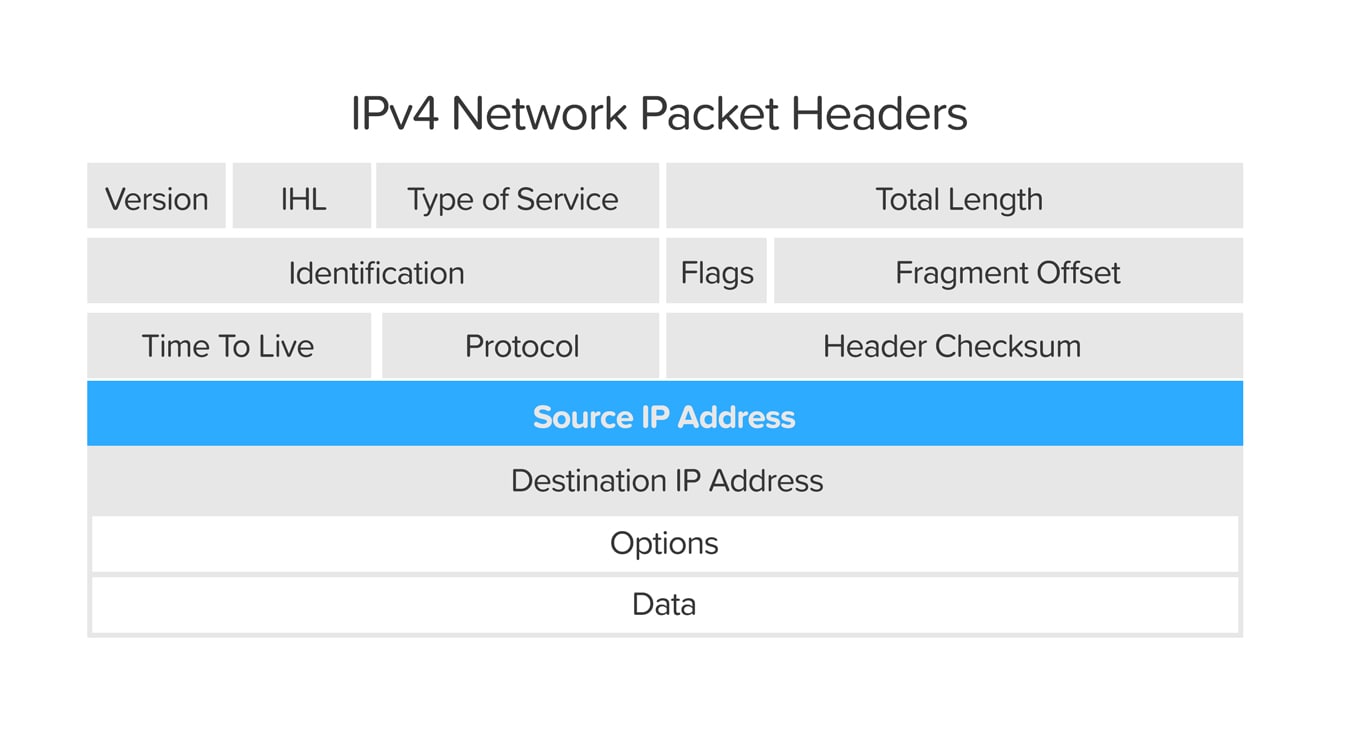
IP spoofing is analogous to an attacker sending a package with a false return address. The recipient cannot determine the true origin from the label, and any response sent to the return address goes somewhere other than the actual sender. In network terms, this means that systems blocking traffic based on source IP address cannot block the real attacker if the source address is forged, and traffic intended as a response to the attacker goes to an innocent third party, which is the mechanism behind DDoS reflection attacks.
How Does IP Spoofing Work?
Data transmitted over the internet is broken into packets, each with an IP header containing the source and destination address. In IP spoofing, the attacker uses software to set the source IP address field in the packet header to a value other than the device’s actual address before transmitting the packet.
Because this manipulation occurs at the network layer (Layer 3 of the OSI model), there are no external signs of tampering visible to the receiving system. The packet arrives and is processed based on the forged address. IP spoofing enables three key attacker advantages:
- Identity concealment: spoofed source addresses prevent the target system and security monitoring tools from determining the attacker’s true IP, protecting the attacker from attribution and blocking.
- Detection evasion: because the compromised system processes packets based on the forged source address (which may be from a trusted range), it does not generate alerts that would fire for traffic from an unknown or blacklisted source.
- Firewall bypass: network controls that allow traffic based on trusted source IP addresses (IP allowlists) can be bypassed if the attacker can forge a trusted source address. This is why IP address alone is not a sufficient authentication mechanism.
Types of IP Spoofing Attacks
| Attack type | How IP spoofing enables it | Primary target | Key defense |
|---|---|---|---|
| DDoS reflection/amplification | Attacker sends requests to servers (DNS, NTP, MEMCACHED) with victim’s IP as the spoofed source; servers send large responses to the victim | Any internet-connected system; especially public-facing web infrastructure | BCP 38 ingress filtering at ISP and enterprise edges; rate limiting; response size caps on reflectable protocols |
| Botnet traffic obfuscation | Botnet members send attack traffic with spoofed source addresses to conceal the botnet’s true membership and prevent IP-based blocking | Target websites and infrastructure; online services | Behavioral detection; traffic analysis not reliant on source address; ingress filtering |
| Man-in-the-Middle (MITM) via ARP spoofing | ARP spoofing at the local network layer uses IP spoofing to redirect traffic through the attacker; attacker intercepts and modifies communications | Local network hosts; enterprise LAN segments | Dynamic ARP Inspection (DAI); TLS with certificate validation so intercepted traffic cannot be read or impersonated |
| Trust-based access exploitation | Attacker forges source IP to match a trusted host, gaining access to systems that grant permissions based on source IP address | Legacy systems using IP-based authentication; network services without mutual authentication | Replace IP-based trust with cryptographic authentication (mutual TLS, SSH with key-based auth); never use source IP alone as an access control mechanism |
| Session hijacking | Attacker forges IP packets to inject data into an existing TCP session, disrupting or taking over the session | Unencrypted TCP sessions; older protocol implementations | TLS (provides session integrity through MAC authentication); modern TCP sequence number randomization |
How to Protect Against IP Spoofing
- Implement ingress and egress filtering (BCP 38): configure routers and firewalls to drop inbound packets whose source address could not legitimately originate from the direction the packet arrived (ingress filtering per RFC 2827) and outbound packets whose source address does not belong to your own network (egress filtering). This prevents your network from being a source of spoofed traffic and limits spoofed traffic reaching your systems from outside. BCP 38 (RFC 2827) and BCP 84 (RFC 3704) define these practices.
- Use secure encryption protocols: enforce TLS 1.3 for all sensitive communications to and from your servers. TLS provides two protections against spoofing-based attacks: server authentication (ensuring the server is who it claims to be, preventing impersonation even if traffic is redirected) and encryption (ensuring intercepted traffic cannot be read). Without TLS, a successful IP spoofing or ARP spoofing attack results in complete exposure of transmitted data.
- Deploy DNSSEC and encrypted DNS: implement DNSSEC on authoritative DNS zones to provide cryptographic integrity verification of DNS responses. Use DNS-over-HTTPS (DoH) or DNS-over-TLS (DoT) for resolver queries to prevent DNS spoofing as a precursor to IP spoofing and MITM attacks. See our blog on DNS Poisoning and Hierarchy Attacks for a full breakdown of DNS attack vectors.
- Configure firewalls to block spoofed address ranges: inbound packets with source addresses from private IP ranges (RFC 1918: 10.0.0.0/8, 172.16.0.0/12, 192.168.0.0/16), loopback addresses (127.0.0.0/8), or other reserved ranges should be dropped at the perimeter, as legitimate internet traffic cannot originate from these addresses.
- Replace IP-based trust with cryptographic authentication: any system that grants access based on source IP address is vulnerable to IP spoofing. Replace IP allowlists with mutual TLS (mTLS) or SSH with key-based authentication for server-to-server communication, and with MFA for user-facing systems. IP address is not an identity; it is a routing label that can be forged.
- Monitor network traffic for anomalies: deploy network intrusion detection systems (IDS) configured to alert on patterns consistent with IP spoofing: packets with source addresses inconsistent with the expected traffic pattern for that interface, ARP table anomalies, and unusual traffic volumes that may indicate a reflection attack is being launched through your network.
- Avoid unsecured public Wi-Fi for sensitive communications: on public networks where ARP spoofing is easy to execute, use a VPN that encrypts all network traffic before it can be intercepted. Even with a VPN, TLS provides an additional layer of encryption for sensitive application traffic.
- Secure home and enterprise Wi-Fi networks: use strong, unique passwords for Wi-Fi network access. For enterprise environments, implement 802.1X authentication so only authenticated devices can connect to the network, eliminating the ability of attackers to join the network and launch ARP spoofing attacks.
Protocol and Algorithm Selection for IP Spoofing Defense
| Control | Recommended configuration | What to avoid | Why it matters |
|---|---|---|---|
| Network layer filtering | BCP 38 ingress filtering + BCP 84 multi-homing filtering at all network borders | Relying solely on source-IP-based allowlists as an access control mechanism | Ingress filtering drops packets with forged source addresses before they reach target systems |
| Transport layer security | TLS 1.3 with ECDHE key exchange and server certificate validation for all sensitive sessions | Unencrypted TCP/UDP sessions for sensitive data; TLS 1.0 or 1.1 | TLS authenticates the server and encrypts the session, limiting the damage from successful IP redirection |
| DNS security | DNSSEC for authoritative zones; DoH or DoT for resolver queries | Unvalidated DNS over UDP/53 only | DNS spoofing is a common precursor to IP spoofing attacks that redirect web traffic |
| Local network ARP protection | Dynamic ARP Inspection (DAI) on managed switches; 802.1X for network access control | Flat network segments with no ARP validation on managed switches | ARP spoofing at the LAN layer enables MITM attacks that bypass IP-layer controls |
| Server-to-server authentication | Mutual TLS (mTLS) or SSH with key-based authentication | IP address as the sole authentication credential for server access | Cryptographic authentication cannot be forged by spoofing an IP address |
Deployment Example: Enterprise IP Spoofing Defense
A financial services organization with public-facing web applications and internal service-to-service APIs implements the following IP spoofing defense layers:
- ISP-level and perimeter ingress filtering: the organization coordinates with its ISP to ensure BCP 38 filtering is in place upstream. At its own perimeter firewall, inbound packets with source addresses from RFC 1918 private ranges, loopback ranges, and the organization’s own IP ranges (which cannot legitimately arrive from outside) are dropped.
- Egress filtering to prevent being a spoofing source: outbound packets with source addresses not belonging to the organization’s own allocated IP ranges are blocked at the egress firewall, ensuring the organization’s infrastructure cannot be used to generate spoofed traffic that would contribute to reflection DDoS attacks against others.
- TLS 1.3 for all public and internal communication: all public-facing web applications enforce TLS 1.3. Internal service-to-service APIs use mutual TLS so that both the client and server authenticate with certificates, eliminating the ability of an attacker who has spoofed an internal IP address to impersonate an authorized service.
- Dynamic ARP Inspection on managed switches: DAI is enabled on all managed switches in the internal network, preventing ARP spoofing within the LAN segments where servers and workstations communicate. DAI validates ARP packets against a trusted DHCP binding table and drops ARP responses that do not match expected pairings.
- DNSSEC on authoritative zones and DoH for resolvers: the organization’s public DNS zones are signed with DNSSEC. Internal resolvers use DoH to prevent DNS response poisoning that could redirect internal service discovery to attacker-controlled addresses.
- Network IDS alerts for spoofing patterns: the IDS is configured to alert on ARP table anomalies, inbound packets with source addresses inconsistent with expected routes, and traffic patterns consistent with reflection attack sourcing.
Limitations of IP Spoofing Defenses
- Ingress filtering requires widespread adoption to be fully effective: BCP 38 ingress filtering is most effective when deployed by ISPs and networks globally. A spoofing attack launched from a network that does not implement BCP 38 filtering can still reach targets whose upstream ISPs have not deployed it. As of publication, ingress filtering is not universally deployed across the internet.
- IP spoofing does not directly bypass TLS: an attacker who has spoofed an IP address and redirected traffic to themselves still cannot read TLS-encrypted sessions without the server’s private key. However, if the server’s private key is compromised, TLS provides no protection regardless of IP spoofing defenses. HSM-backed private key storage mitigates this risk.
- ARP spoofing is a local network attack: Dynamic ARP Inspection protects against ARP spoofing on managed switch segments, but it requires managed switches and correct DHCP snooping configuration. Unmanaged network equipment cannot enforce DAI.
- IP-based authentication cannot be made secure: no technical control fully secures a system that relies on source IP address as a sole authentication mechanism. IP spoofing, NAT environments, and shared egress infrastructure all undermine IP-based trust. The correct defense is eliminating IP-based authentication in favor of cryptographic authentication.
How Encryption Consulting Can Help
- Encryption Advisory Services: our Encryption Advisory Services assess your TLS configuration across public-facing and internal services, identify systems that rely on IP-based trust instead of cryptographic authentication, and recommend remediation plans including mTLS deployment for service-to-service communication.
- PKI as a Service: our PKI as a Service provides the certificate infrastructure needed to deploy mutual TLS for internal APIs and service-to-service communication, enabling cryptographic authentication that cannot be bypassed by IP spoofing.
- CertSecure Manager: CertSecure Manager manages the lifecycle of TLS certificates used across your environment, ensuring certificates are renewed before expiry and that the certificate infrastructure supporting your spoofing defenses remains operational.
- HSM as a Service: HSM as a Service protects the private keys behind your TLS certificates in FIPS 140-3 validated hardware, ensuring that even if an attacker gains access to your server environment, they cannot extract the private keys needed to decrypt TLS sessions or impersonate your services.
Legitimate Uses of IP Spoofing
IP spoofing is used in authorized contexts for performance and security testing. Organizations may use IP address spoofing to simulate thousands of virtual users during load testing of web applications, to test whether ingress filtering correctly drops spoofed traffic, or in authorized penetration testing to verify that firewall rules and IDS alerts behave as expected when spoofed traffic is received. These uses require explicit authorization and are conducted in controlled environments to prevent unintended impact on production systems or other networks.
Conclusion
IP spoofing exploits a fundamental property of the IP protocol: the source address field in a packet header can be set to any value the sending device chooses. This enables attackers to conceal their identity, bypass IP-based access controls, and direct amplified DDoS traffic at victims. The defenses are well-established and complementary: ingress and egress filtering at network borders eliminates most spoofed traffic before it reaches targets; TLS with certificate validation ensures that even successfully redirected traffic cannot be read or impersonated; and replacing IP-based trust with cryptographic authentication removes the vulnerability that IP spoofing most directly exploits. For related topics, see our guide on Man-in-the-Middle Attacks and DNS Poisoning.
Frequently Asked Questions
What is IP spoofing?
IP spoofing is the creation of IP packets with a forged source address to conceal the attacker’s identity, impersonate a trusted host, or direct response traffic to a victim (for DDoS reflection). It occurs at the network layer before application security can detect it, and there are no external signs of tampering visible to the receiving system.
What is the difference between IP spoofing, ARP spoofing, and DNS spoofing?
IP spoofing forges source addresses in packet headers at the network layer. ARP spoofing poisons local network ARP tables to redirect LAN traffic through the attacker. DNS spoofing corrupts resolver caches to redirect domain name lookups to attacker-controlled servers. All three can be components of larger MITM or DDoS attacks.
How does ingress filtering stop IP spoofing?
Ingress filtering (BCP 38, RFC 2827) drops incoming packets whose source address could not legitimately originate from the interface on which they arrive. A packet arriving from outside your network with a source address from your own IP range, a private range, or a reserved range is dropped because no legitimate external sender can have those addresses. Widely deployed at ISP and enterprise edges, it makes IP spoofing significantly harder.
Does TLS protect against IP spoofing?
TLS does not prevent IP spoofing at the network layer, but it limits its impact: even if an attacker redirects traffic to themselves, they cannot decrypt TLS sessions without the server’s private key, and cannot impersonate a server without a valid TLS certificate for the correct domain. TLS is a complementary control, not a replacement for network-layer filtering.
How are DDoS attacks connected to IP spoofing?
In DDoS reflection/amplification attacks, the attacker sends requests to third-party servers with the victim’s IP as the spoofed source. The servers send large responses to the victim, flooding them with traffic they never requested. IP spoofing enables this by making the requests appear to come from the victim. BCP 38 ingress filtering prevents attackers from sourcing such traffic from networks where it is deployed.
What organizational controls protect against IP spoofing?
Key controls include BCP 38/84 ingress and egress filtering; TLS for all sensitive communications; DNSSEC and DoH/DoT for DNS integrity; Dynamic ARP Inspection on managed switches; 802.1X authentication for network access; replacing IP-based trust with mTLS or SSH key authentication; and network IDS monitoring for anomalous source address patterns.
- Quick Answer: What Is IP Spoofing and How Do You Protect Against It?
- What Is Spoofing?
- What Is IP Spoofing?
- How Does IP Spoofing Work?
- Types of IP Spoofing Attacks
- How to Protect Against IP Spoofing
- Protocol and Algorithm Selection for IP Spoofing Defense
- Deployment Example: Enterprise IP Spoofing Defense
- Limitations of IP Spoofing Defenses
- How Encryption Consulting Can Help
- Legitimate Uses of IP Spoofing
- Conclusion
- Frequently Asked Questions